

Eleven weeks ago I pushed the first binary of Tabularis to GitHub. A database client. One person, a late-night frustration, a Tauri app with a SQL editor and not much else.
Last week, ten weeks in, the repo crossed 1,000 stars. Today, at week eleven, there are 1,086 stars, 70 forks, 15 contributors, 41 releases, and a plugin ecosystem that didn't exist eight weeks ago. The project started as "debba.sql". I renamed it to Tabularis a few days in because I wanted it to feel like something bigger than a personal tool.
It became bigger than a personal tool. Not because of a launch strategy. Because people showed up.
This post is what I'd tell myself ten weeks ago if I could go back. Not a growth playbook (those already exist and most of them are noise). This is what actually happened, what I think mattered, and what I got wrong.
Week 1: Ship Fast, Ship Broken, Ship Anyway
The first week produced fifteen releases. Fifteen. From v0.2.0 to v0.8.6. Some of them were embarrassing. I shipped a version that crashed on Wayland. I shipped a version where the database dropdown didn't work properly. I shipped anyway.
Here's what I learned: nobody remembers your v0.3.0. People remember whether the tool was useful when they tried it, and whether it got better when they came back. Shipping fast builds that muscle: the ability to push a fix in hours, not weeks. By the end of week one the release pipeline was solid, the update flow worked, and I had the confidence that I could fix anything that broke within a day.
The alternative, polishing in private for months, would have meant launching into silence. Instead, the first few users arrived while the project was still rough, and they stayed because they could see it moving.
Week 2-3: The First External Contributor Changes Everything
@niklasschaeffer opened the first external PR in week two: support for custom OpenAI-compatible API endpoints. It was a clean, well-scoped contribution. It also changed my relationship with the project overnight.
Before that PR, Tabularis was my code. After it, Tabularis was a codebase other people could read, understand, and modify. That shift, from "my project" to "our project", is the most important thing that happened in the first month.
By week three, @kconfesor contributed PostgreSQL schema selection and a full Spanish locale. Someone I'd never met decided the tool was worth translating into their language. That's a signal no star count can match.
What I'd do differently: I should have written contributor documentation from day one. The first contributors succeeded despite the lack of guides, not because of them.
Week 4-5: The Plugin System, the Bet That Paid Off
At the one-month mark we had ~270 stars and 5 contributors. Good momentum. But the decision that actually changed the trajectory was shipping the plugin system in v0.9.0.
A language-agnostic JSON-RPC protocol. Any language, any database. The first plugin (DuckDB) was ready on day one. Within two weeks the community had added Redis, ClickHouse, CSV, and a Hacker News plugin that turned a public API into a SQL-queryable database.
The plugin system did three things at once:
It multiplied what Tabularis could do without multiplying my workload. I didn't write the Redis driver. I didn't write the ClickHouse driver. The community did.
It gave contributors a sandbox. Writing a plugin is self-contained: you don't need to understand the Tauri backend or the React frontend. That dramatically lowered the barrier to contribution.
It changed the story. Tabularis went from "a database client that supports three databases" to "a platform that can support any database." That's a much more interesting pitch.
Lesson: building an extension point early is one of the highest-leverage things a solo maintainer can do. It turns users into builders.
Week 6-8: Momentum Compounds
This is the phase where everything started compounding. New contributors arrived every release. @gzamboni and @nicholas-papachriston with the Redis plugin. @SergioChan fixing modal behavior. @sycured adding PostgreSQL SSL modes. @fandujar building connection groups. @GreenBeret9 fixing SQLite issues.
Three things were happening simultaneously:
The product was improving faster than I could improve it alone. Community PRs were shipping features I hadn't planned: connection string import, drag-and-drop, bug fixes for databases I don't even use daily.
The blog was building trust. I wrote about every major release, honestly. What worked, what didn't, what was coming. The HN plugin post was as much a stress test report as a feature announcement. People responded to that transparency.
Word of mouth was doing the work. I never paid for promotion. Never ran ads. I did post on Reddit, Hacker News, X, Daily.dev, and dev.to, but from there the growth took on a life of its own: people sharing Tabularis in Slack channels, blog posts, and conversations I never saw.
Lesson: consistency > virality. A new release every few days, a blog post every week, a Discord channel where questions get answered. That steady rhythm builds more trust than any single launch.
Week 9-10: International, AI-Powered, Notebook-Ready
The last few weeks brought some of the most exciting contributions:
- Chinese (Simplified) language support from @GTLOLI, the first Asian locale, opening up Tabularis to a massive developer community.
- MiniMax as a first-class AI provider from @octo-patch, expanding the AI assistant beyond the usual suspects.
- Extended PostgreSQL type support from @dev-void-7: arrays, JSON, custom types. The kind of deep, unglamorous work that makes a database tool actually reliable.
- SQL Notebooks, the biggest feature release since the plugin system. Cell-based SQL analysis with inline charts, cell references, parameters, and parallel execution. Built directly into the app.
And last week, @thomaswasle contributed drag-and-drop for connection groups. A small feature, but it represents something important: people are building the tool they want to use, not just the tool I envisioned.
The Numbers, Honestly
The 1,000-star milestone landed at week ten. Here's where things stand today, one week later:
| Metric | Week 4 | Week 10 | Week 11 (today) |
|---|---|---|---|
| Stars | ~270 | 1,000 | 1,086 |
| Contributors | 5 | 14 | 15 |
| Releases | 17 | 39 | 41 |
| Forks | — | 65 | 70 |
| Plugins | 1 | 7 | 7 |
| Languages | 2 | 4 | 4 |
| Issues | — | ~70 | 81 |
| Pull Requests | — | ~35 | 41 |
| Downloads | — | ~6,000 | 7,100+ |
One thing that surprised me: where those stars come from. About half of our stargazers have a public location on their GitHub profile, and they span 72 countries across every continent:
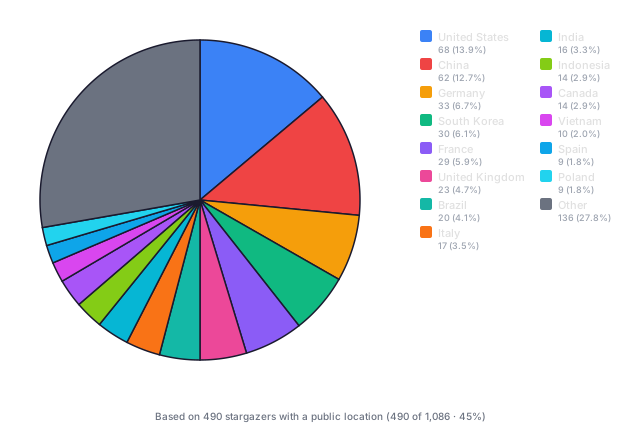
The United States and China lead, but what stands out is the long tail: South Korea, Germany, France, Brazil, Indonesia, Vietnam. Tabularis isn't a tool for one market. It's a tool for developers, and developers are everywhere.
The download breakdown by operating system tells a complementary story. Windows leads at 40.8%, followed by macOS at 32.3% and Linux at 26.9%:
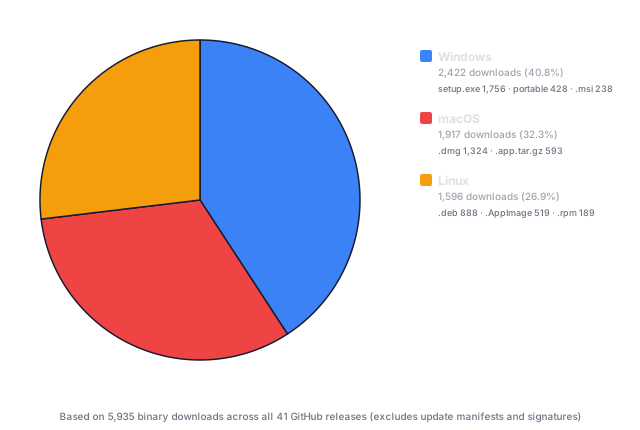
What I find encouraging is that all three platforms have meaningful adoption. The Linux share is especially notable for a desktop app — it reflects the developer audience we're building for. And within each OS, the format diversity (setup vs. portable on Windows, .deb vs. AppImage vs. .rpm on Linux) suggests people are actually integrating Tabularis into their workflows, not just trying it once.
These numbers feel good. But I want to be honest about what they don't measure.
Stars are a vanity metric. I know that. A star doesn't mean someone uses Tabularis daily, or that it solved a real problem for them, or that they'll come back for v0.10. What I care about more: issues opened by people who actually tried the product. PRs from people who cared enough to fix something. Messages on Discord from people running Tabularis against their production databases.
1,000 stars is a milestone worth marking. It's not a destination.
What Didn't Work
Not everything landed. A few honest misses:
Documentation lagged behind features. The wiki exists, but it's still thin. Features shipped faster than docs, and some users bounced because they couldn't figure out setup. This is the biggest gap I need to close.
Windows testing was always behind. Most contributors (including me) develop on macOS or Linux. Windows bugs took longer to surface and longer to fix. A few early Windows users had a rough experience.
I underestimated the support load. Solo maintainer math: every new feature creates new questions. Every new plugin creates new edge cases. I love that people are engaged. I'm still learning how to scale my attention.
The AI Factor
I need to be honest about something: Tabularis would not exist without AI-assisted development. Specifically, without Claude Code.
A Tauri app with a Rust backend, a React/TypeScript frontend, a plugin system, an MCP server, SQL notebooks, and 41 releases in eleven weeks. One person. That math doesn't work without a force multiplier, and AI was that multiplier.
But here's the part that gets lost in the hype: AI doesn't replace experience. It amplifies it. Claude Code didn't design the plugin architecture. It didn't decide that JSON-RPC was the right protocol, or that the credential cache needed to wrap the system keychain, or that the notebook execution model should support parallel cells. Those decisions came from years of building software, understanding trade-offs, and knowing what users actually need.
What AI did was collapse the distance between a decision and its implementation. Once I knew what to build, I could build it in hours instead of days. The Rust backend, the React components, the test suites, the CI pipeline: Claude Code handled the volume while I handled the direction.
The analogy I keep coming back to: AI is like having an incredibly fast junior developer who never gets tired and knows every API. Powerful, but only if you know what to ask for. Without a clear architectural vision, without the experience to spot when the output is subtly wrong, without the judgment to know which corners not to cut, you just get bad code faster.
Three years ago, Tabularis would have been a side project that took a year to reach v0.5. Today it's at v0.9.16 with a real community. The difference isn't just speed. It's that AI let me stay in the creative, architectural layer, the part that actually matters, instead of spending most of my time on implementation details.
If you're an experienced developer and you're not using AI-assisted tools yet: try it. Not as a replacement for thinking, but as a way to spend more of your time on the thinking that counts.
Finding Tabularis useful? Star it on GitHub — it takes a second and helps more developers discover the project. Star on GitHub
What I'd Tell Someone Starting Today
If you're building an open source project and wondering whether it can find an audience, here's what I actually believe after ten weeks:
Ship before you're ready. Your first version will be embarrassing in retrospect. That's fine. The feedback you get from real users in week one is worth more than three months of private iteration.
Build an extension point early. A plugin system, a hook system, a theme system — anything that lets other people build on top of your work without needing your permission or your codebase knowledge.
Write about what you're building. Blog posts, release notes, changelogs. Not marketing copy. Honest accounts of what you built and why. People can tell the difference.
Respond to every contributor. Review PRs quickly. Say thank you publicly. The first five contributors set the culture for the next fifty.
Don't ask for stars. Build something useful. The stars follow.
What's Next
The plugin ecosystem is growing but still young. Notebooks need polish: performance with large documents, circular reference detection, keyboard navigation. The AI features are useful but could be smarter about schema context. And the documentation needs serious attention.
Beyond specific features: I want Tabularis to be the database client that developers actually enjoy using. Not the one with the most features on a comparison chart, but the one that feels fast, looks good, and gets out of your way. That's been the north star since day one, and it hasn't changed.
We're also approaching a plugin registry redesign, better onboarding for new contributors, and, if the community keeps growing at this pace, the possibility of Tabularis becoming more than a solo-maintained project.
Thank You
1,000 stars means 1,000 people decided this project was worth remembering. Some of them went further — they opened issues, submitted PRs, translated the interface, wrote plugins, and helped shape what Tabularis is becoming.
A special thanks to our sponsors: turboSMTP, Kilo Code, and Usero. They believed in the project early and help keep it free and independent. Their support covers development time that would otherwise come entirely out of pocket.
To every contributor, every user, every person who mentioned Tabularis to a colleague or dropped a link in a chat: thank you. This stopped being a solo project the moment you showed up.
If you want to get involved, the Discord is the fastest way in. Come say hi. There's plenty to build.
Here's to the next thousand.
The Tabularis Team