

v0.14.0 bumps the minor line because it stops being a database viewer in a few more places and starts being a database client. It manages stored procedures and functions the way it already manages tables and views, it lets a connection live in its own window, it browses PostgreSQL materialized views, and — the change everyone will feel eventually — it asks before you run the query that wipes a table. It follows v0.13.4, and like that release most of the surface area came from the community: @Davydhh alone lands six of the changes below.
Manage Stored Routines, Not Just Tables
Stored procedures and functions have always been visible in the sidebar. As of v0.14.0 you can actually do something with them. PR #416 adds full routine management — run, create, edit, and drop — behind a new routine_management driver capability enabled for MySQL and PostgreSQL out of the box.
- Run with parameters. A modal collects each
IN/INOUTvalue — with a NULL checkbox and a raw-value toggle that defaults on for numeric types — and the driver assembles a reviewable invocation script before anything executes. MySQLOUT/INOUTparameters are threaded through session variables (SET/CALL/SELECT @var); PostgreSQL functions run asSELECT * FROM fn(...), so a set-returning function comes back as an actual result set. - Create from a template. A dialect-aware starter script —
DELIMITER-wrapped for MySQL,CREATE OR REPLACEwith dollar-quoting for PostgreSQL — so you're editing a valid skeleton, not a blank buffer. - Edit the definition. A re-runnable script: MySQL wraps
SHOW CREATEin aDROP IF EXISTS+DELIMITERblock, PostgreSQL reusespg_get_functiondef. - Drop with confirmation. PostgreSQL resolves the exact identity signature via
pg_get_function_identity_argumentsand refuses to guess between overloads rather than dropping the wrong one.
For plugin drivers the four new methods are optional JSON-RPC calls: when a plugin doesn't implement one, the host falls back to the same generic SQL, so a driver only overrides what its dialect actually needs. The manifest schema documents the capability.
Video unavailable
A Connection in Its Own Window
The results panel learned to detach in v0.13.4. In v0.14.0 the connection itself can. PR #409 adds an Open in New Window action to both connection context menus — the open-connections sidebar rail and the Connections page — that spins a connection out into its own standalone OS window.
The plumbing is the interesting part. Connectivity is validated before the window is spawned: the connection is test-connected first and the window is only created on success, so a failing connection surfaces its error in the window you're already in rather than a freshly-opened empty one. A connection opened in a new window is owned by that window and detached from the originating sidebar rail, though its process-global pool stays warm and is reused. Open-state is shared across every window — a connection open anywhere shows as open in every window's Connections page, broadcast via a new connections:active-changed event. Disconnecting closes the dedicated window (the main window is never auto-closed), and closing a dedicated window tears its connection down so nothing leaks.
Video unavailable
Confirm Before You Wipe a Table
A DELETE or UPDATE with the WHERE clause forgotten is one of the oldest ways to lose data with no way back. PR #429 puts a guard in front of it. Both the SQL editor and notebook cells now detect a DELETE/UPDATE with no WHERE, as well as DROP and TRUNCATE, and ask for confirmation before the query is sent.
The detection isn't a naive substring match: it looks past comments and string literals (including backslash-escaped quotes), understands data-modifying CTEs, and handles multi-statement batches. The dialog shows kind-specific copy and a read-only preview of the exact statement it flagged, and the confirm button stays disabled for a five-second countdown — long enough that the warning is actually read instead of reflexively dismissed.
Video unavailable
PostgreSQL Materialized Views
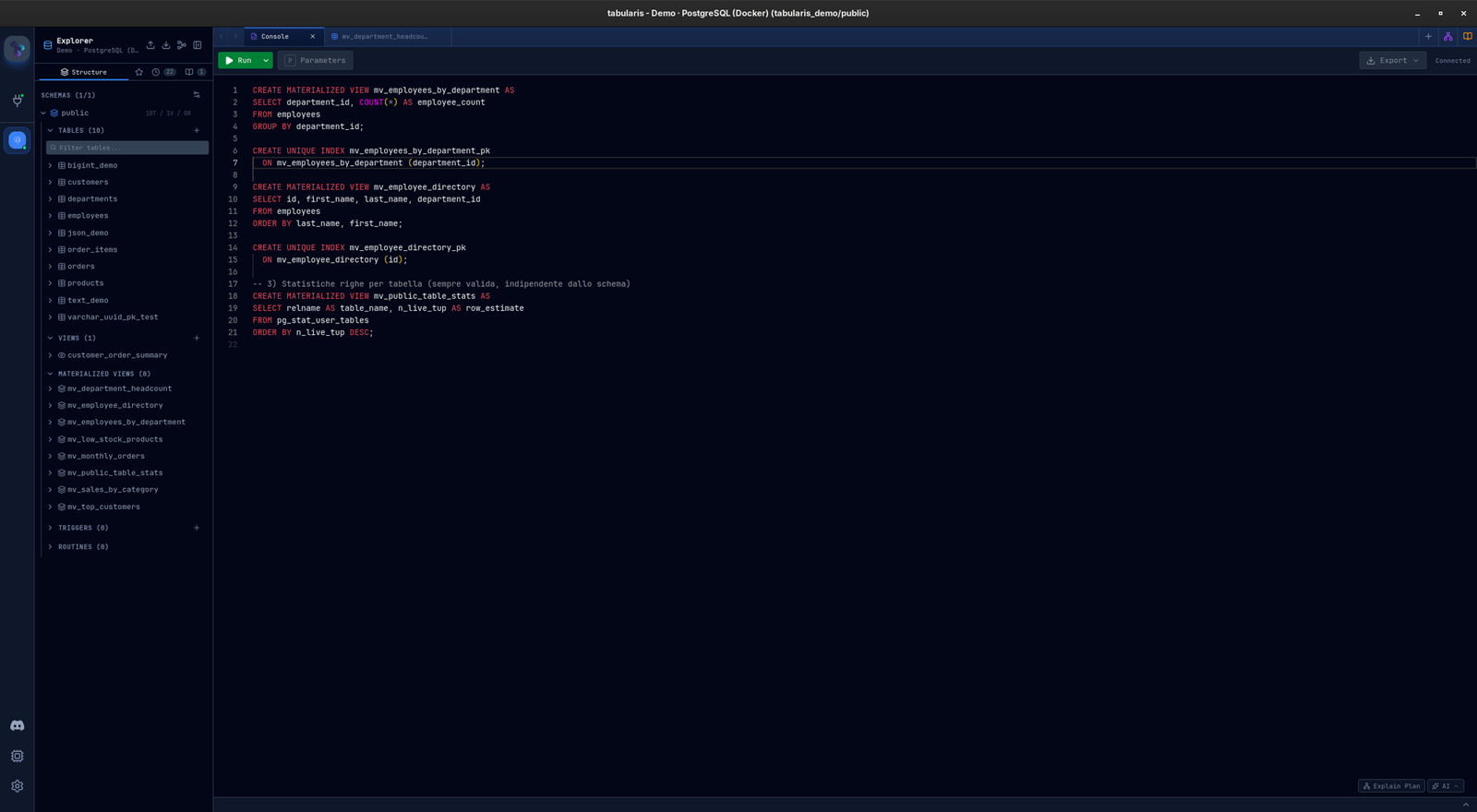
@Davydhh added first-class materialized view support for PostgreSQL in PR #342. They show up as their own sidebar group (collapsed by default), gated on a driver capability so only databases that have them render the section. You get an in-flight spinner while a refresh runs, the same index-list rendering that tables use, and the view's columns — resolved against the active schema. They're read-only in the data grid, as a materialized view should be.
Find Things by Typo
Three changes, all from @Davydhh, make finding an object forgiving of how you actually type.
The table and trigger filters swapped their substring match for Fuse.js fuzzy matching in PR #417, so ordrs still finds orders and the closest names rank first — applied across the schema, per-database, and flat sidebar layouts through one shared helper. The Quick Navigator got the same treatment in PR #421. And PR #412 adds a rebindable focus-table-filter shortcut (⌘⇧F / Ctrl+Shift+F) that jumps straight to the filter box in whichever layout is showing, even while another input has focus.
Video unavailable
Know Exactly How Many Rows
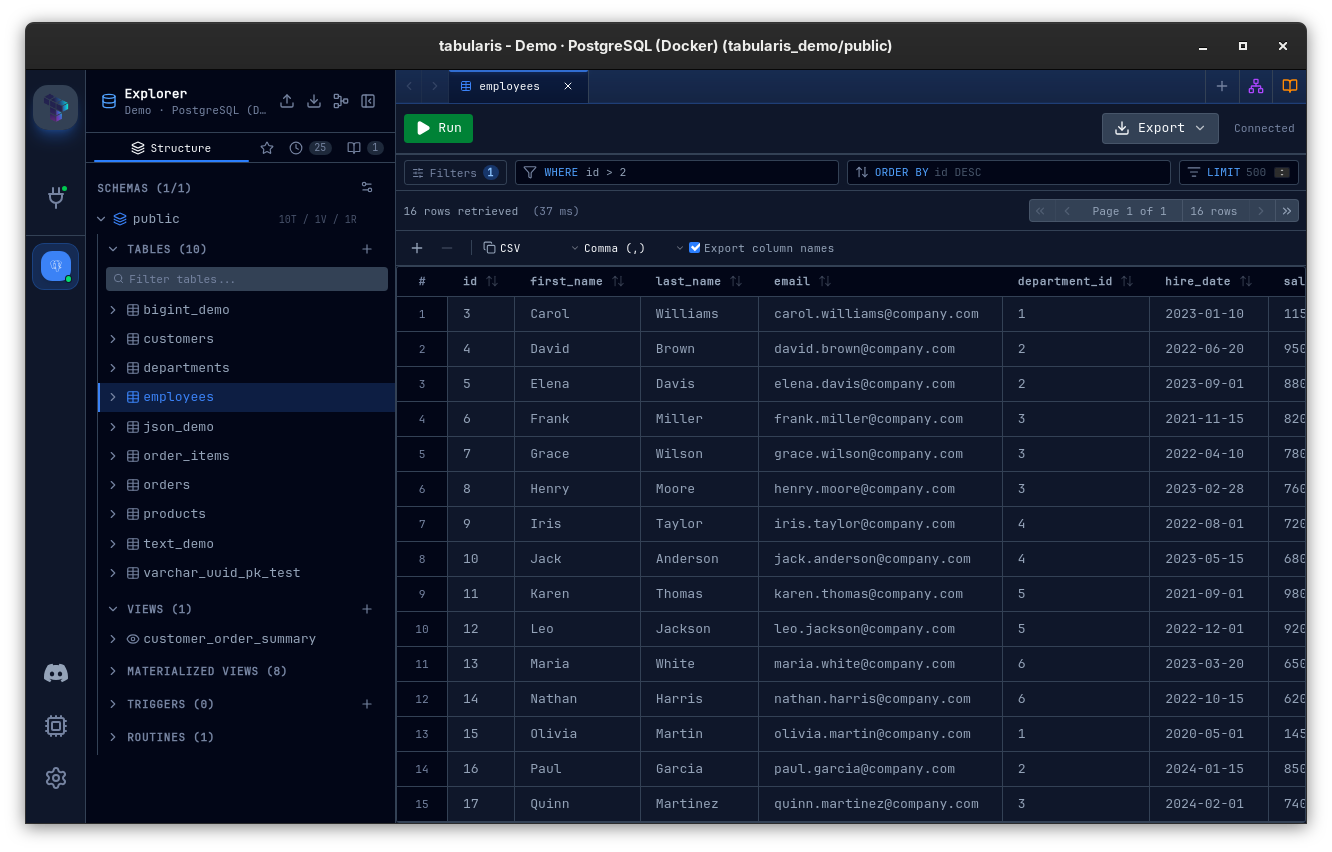
The pager used to tell you which page you were on but not how big the result was. PR #410, also from @Davydhh, displays the exact {total} rows next to the page indicator — and counts the right query. The old count ran against the base table and ignored the filter box's WHERE, so a filtered grid reported the unfiltered total; it now counts the reconstructed filtered query. The count resets when the query or filter changes so a stale number from a previous run never lingers, but it's preserved across pagination.
MySQL Through Warpgate
@pokertour added an opt-in cleartext password plugin toggle for MySQL/MariaDB in PR #337 (closes #336), so connections can authenticate through bastions like Warpgate that require the mysql_clear_password auth plugin. Because those bastions proxy MySQL without implementing the prepared-statement protocol, any prepared query failed with server error 1047; when the toggle is on, the driver routes everything through the text protocol instead. The option is gated on an enforced TLS mode — cleartext credentials are refused over a link that could silently fall back to plaintext — and string literals become sql_mode-aware so NO_BACKSLASH_ESCAPES targets escape correctly. A pool cache-key collision that let two Warpgate targets behind one host:port share a pool was fixed at the same time.
Correctness, Across the Board
- Temporal and UUID cell edits on PostgreSQL (@NewtTheWolf, PR #408, fixes #401) — editing a
timestamp/timestamptz/date/time/intervalcell failed witherror serializing parameterbecause the client inferred the parameter type from the cast target and rejected the bound string before PostgreSQL's own parsing ran. Every bound parameter now declares its wire type explicitly viaprepare_typed/execute_typed, which also finishes the UUID-shaped-string fix that #394 only started. Verified against a live PostgreSQL 16. - Composite indexes in generated SQL (@snvtac, PR #373) — multi-column indexes are preserved in the SQL Tabularis generates instead of being flattened to single-column ones.
- MySQL view DDL through the text protocol (@danielnuld, PR #390) — view DDL is routed through the text protocol so it executes correctly.
- MySQL routine DDL through the text protocol (@Stiwar0098, PR #348) — the same treatment for routine DDL, and compound routines are now classified as DDL in the MCP layer (#385).
- Qualified view definitions on PostgreSQL (@debba, PR #400) —
pg_get_viewdefwas called with$1::regclassdirectly, which failed for a bound text value; casting through text first (($1::text)::regclass) resolves qualified view names correctly. - Plugin driver filters in the connection modal (@debba, PR #424) — a missing
driverfield made serde silently drop the filter onui_extensionsmanifest entries, so every plugin's connection-content contribution rendered for every driver and plugins could overwrite each other's connection state. The filter is preserved now.
Smaller Things
- Node 24 (@Davydhh, PR #422) — the toolchain moves to Node 24.
- Sidebar filter clear button (@viniciusmelocodes, PR #403) — the clear (X) button no longer overlaps the scrollbar in the table filter.
Thanks
Most of v0.14.0 is community work again.
@Davydhh carried an outsized share of this release: PostgreSQL materialized views (#342), fuzzy matching for the table and trigger filters (#417), fuzzy search in the Quick Navigator (#421), the focus-table-filter shortcut (#412), the total-row-count display (#410), and the Node 24 upgrade (#422).
@pokertour added MySQL cleartext-auth support for Warpgate bastions (#337). @NewtTheWolf fixed temporal and UUID cell edits on PostgreSQL via explicit wire types (#408). @Stiwar0098 routed MySQL routine DDL through the text protocol (#348) and classified compound routines as DDL in the MCP layer (#385).
@snvtac preserved composite indexes in generated SQL (#373), @danielnuld routed MySQL view DDL through the text protocol (#390), and @viniciusmelocodes fixed the sidebar filter's clear button (#403).
If you manage stored procedures, spread work across monitors, run against PostgreSQL materialized views or a Warpgate-fronted MySQL, or have ever typed a DELETE faster than you meant to — this is the upgrade.


v0.14.0 is available now. Update via the in-app updater, or download from the releases page.