tabularis
/blog/Andrea Debernardi
Andrea Debernardi

Andrea Debernardi

Developer & creator of Tabularis. Building open-source tools for developers. @debba
56 posts

Tabularis Joins the SignPath.io Open Source Program

Tabularis has been accepted into the SignPath.io open source program: a free code signing certificate from the SignPath Foundation for our Windows releases. Over the next few weeks we'll wire signing into the release pipeline — and then the days of telling users to click 'More info → Run anyway' are over.

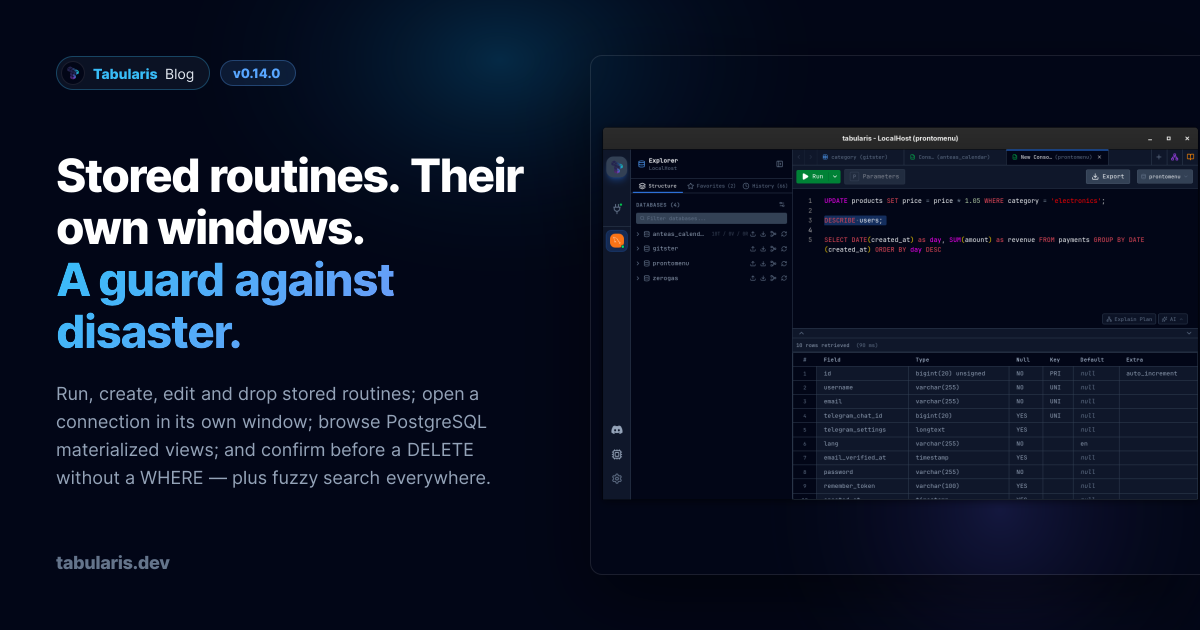
v0.14.0: Stored Routines, Windows of Their Own, and a Guard Against the Unrecoverable

v0.14.0 opens the 0.14 line: manage stored procedures and functions from the sidebar, pop a connection into its own window, browse PostgreSQL materialized views, and get a confirmation dialog before a DELETE without a WHERE — plus typo-tolerant fuzzy search everywhere and a stack of Postgres/MySQL correctness fixes.

Tabularis Joins the JetBrains Open Source Program

JetBrains accepted Tabularis into its Open Source Support program and handed the maintainers a free All Products Pack — which means the editor we write Tabularis in is now, technically, invested in Tabularis existing.

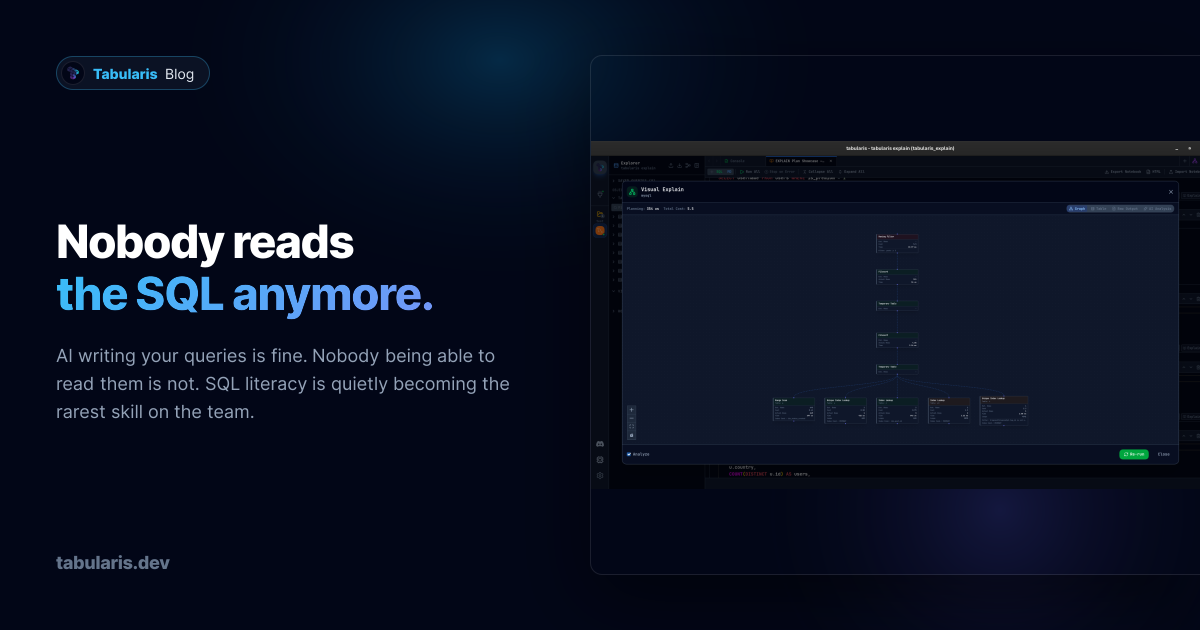
Nobody Reads the SQL Anymore

AI writing our queries is fine, and often better than fine. But reading skill was funded by writing, and now that the writing is gone, the reading is decaying while the volume of SQL entering our codebases goes up. Some thoughts on why SQL is the worst possible language for this to happen to.

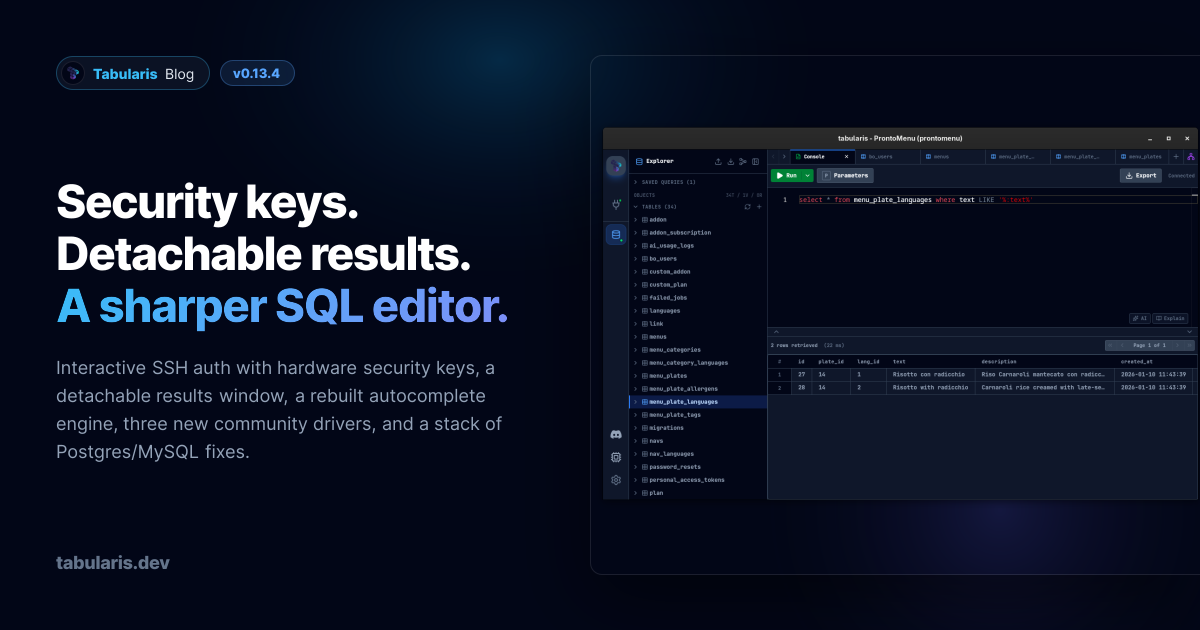
v0.13.4: Unlock Everything — Hardware Keys, Free-Floating Results, and a Sharper Editor

v0.13.4 teaches SSH to prompt — unlock a hardware security key or a passphrase from an in-app dialog — pops query results out into their own window, overhauls SQL autocomplete, and lands three new community drivers (MongoDB, Cloudflare D1, Dameng) alongside a wave of correctness fixes.

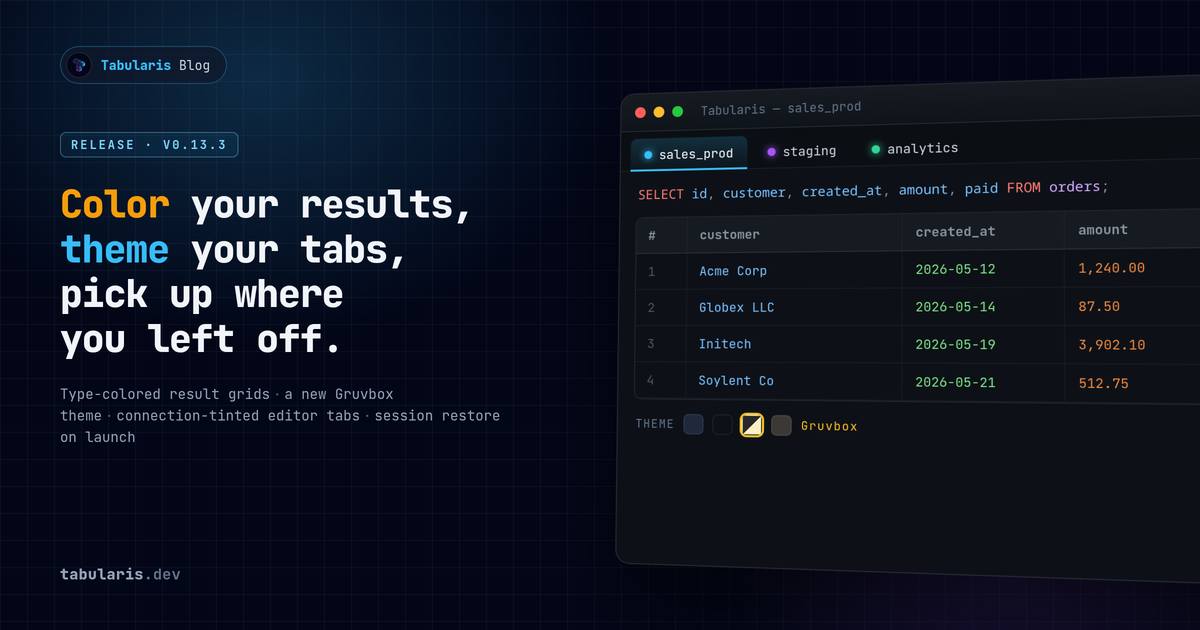
v0.13.3: Color Your Results, Theme Your Tabs, and Pick Up Where You Left Off

v0.13.3 is a personalization release: color query results by data type, dress the editor in a new Gruvbox theme, tint the tab bar with each connection's color, reopen the connections you had last session, and toggle CSV headers when you copy — plus a community Informix driver, driver-aware Kubernetes ports, and louder MCP approval alerts.

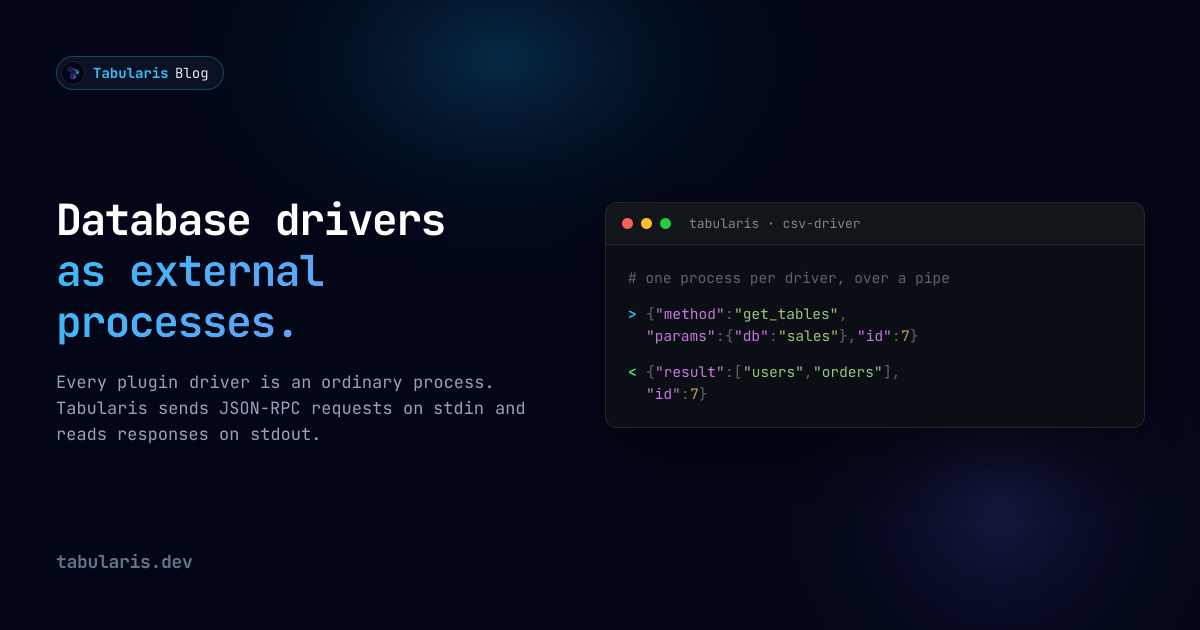
Database drivers as external processes

About three months ago I added support for plugin drivers outside the Tabularis process. External drivers are ordinary programs speaking JSON-RPC over stdin/stdout. This is a retrospective on why that design held up, where it leaked, and the credential bug hidden in a HashMap insert.

Tabularis Joins the Vercel Open Source Program

Tabularis has been accepted into Vercel's Open Source Program for the Spring 2026 cohort. Twelve months of support for the site you're reading right now — which is open source, built with Next.js, and about to get a lot better.

v0.13.2: Notebooks You Can Manage, Query Progress in Real Time, and a Grid That Scrolls

v0.13.2 turns notebooks into a managed, per-connection workspace with undo and a visual history, streams query progress live while a batch runs, makes wide-table scrolling fluid again, teaches autocomplete to read your clauses across databases, and corrects the numbers in Visual EXPLAIN.

We Vibe-Coded a Database-Themed Platformer

We gave Fable 5 a single day and accidentally shipped a browser platformer themed entirely around Tabularis — three database worlds, boss mascots, hidden plugins. It's free, it's open source, and we're not game developers. If you are, let's build new worlds together.

Fable 5 Opened a 1,800-Line PR on Tabularis in 30 Minutes

A Tabularis dev experiment: we asked Fable 5 to add a CLI to the app and went to make coffee. We came back to a draft PR — 1,800 lines of Rust, 37 tests, a refactor we'd have done ourselves, and two pre-existing bugs quietly fixed.

v0.13.1: Signed macOS Builds, a Postgres Explain That Finally Runs, and Pagination That Honors Your OFFSET

v0.13.1 is a correctness pass on v0.13.0: macOS builds are now code-signed and notarized, the Postgres Explain Plan that never worked now runs, paginated queries stop dropping your OFFSET, postgresql:// and mariadb:// connection strings are accepted, the MCP read-only gate stops misreading a parenthesized SELECT as a write, the grid no longer freezes on giant JSON cells, and the macOS Keychain stops prompting on every AI-tab open.

Tabularis Wins a SourceForge Rising Star Award

SourceForge has recognized Tabularis with a Rising Star award — given to a select group of projects out of more than 500,000 for the downloads and engagement they've earned from the community. We're honored, and it belongs to all of you.

Your Database GUI Shouldn't Need an Account

A database client is the most credential-dense application on a developer's machine. Routing any part of it through a vendor account inverts the trust model — and you usually find out why that matters on the day the vendor pivots.

v0.13.0: Kubernetes Tunnels, a Quick Navigator, and MCP That Reaches Your Plugins

v0.13.0 adds first-class Kubernetes port-forward tunnels alongside SSH, a Cmd+P Quick Navigator for jumping to any table in any database, MCP access to plugin-driven connections, a closed multi-statement bypass in the MCP safety gates, Codex as an MCP install target, DML tabs in Generate SQL, a configurable display timezone, self-healing query history, and MySQL SSL modes that are actually honored.

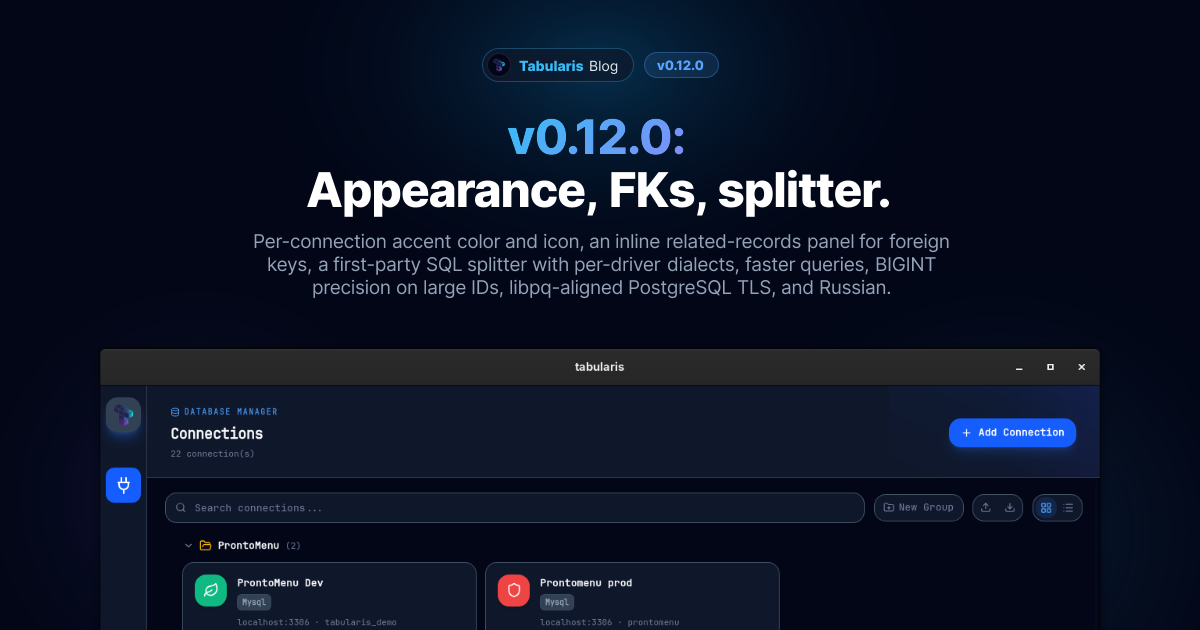
v0.12.0: Per-Connection Appearance, Related Records, and a SQL Splitter We Own

v0.12.0 lets you paint each connection with its own accent color and icon, peek at the row behind any foreign key without leaving the grid, ship a first-party SQL splitter with per-driver dialects, make queries feel snappier, fix BIGINT precision on large IDs, align PostgreSQL TLS with libpq, add Russian, and clean up a long tail of editor and grid papercuts.

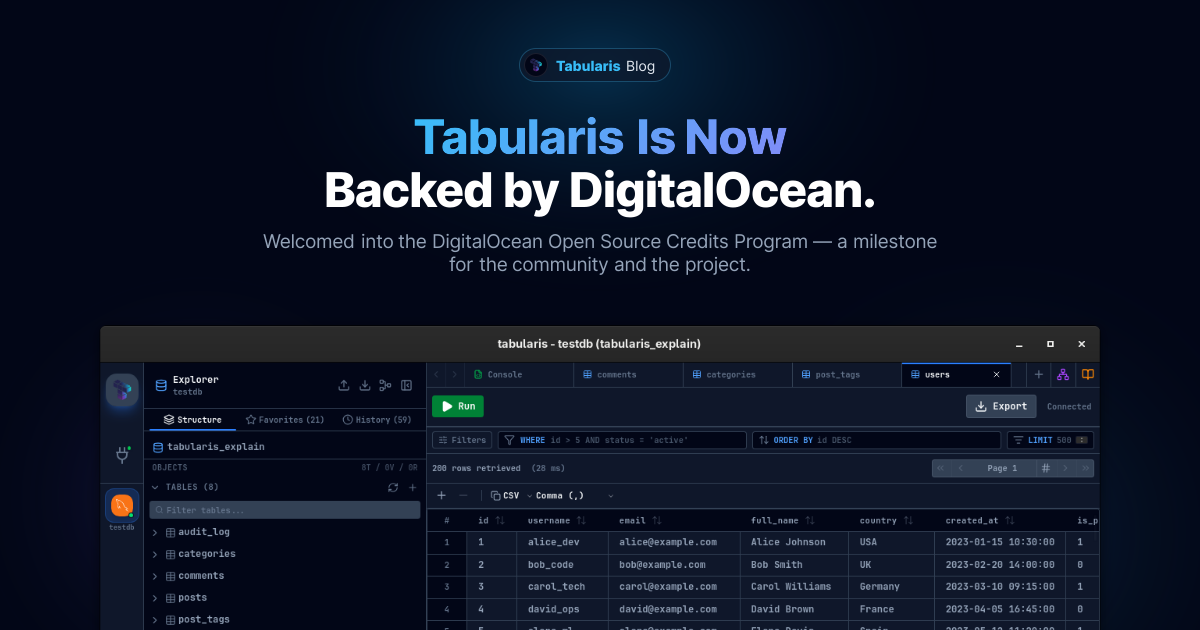
Tabularis Is Now Backed by DigitalOcean

DigitalOcean has welcomed Tabularis into its Open Source Credits Program. A milestone for the project, a vote of confidence from one of the cloud providers that built its name on supporting developers, and a real boost for what comes next.

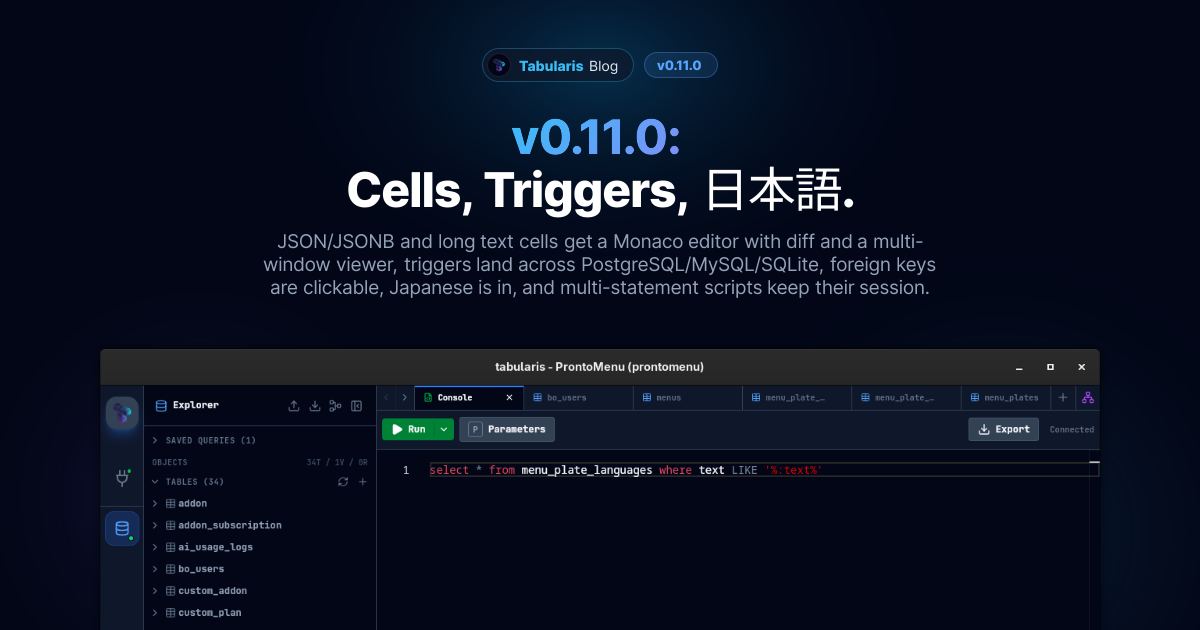
v0.11.0: A Real Editor Inside Every Cell, Triggers, and 日本語

v0.11.0 puts a Monaco-grade editor with diff inside JSON, JSONB and long text cells (in a dedicated Tauri window, even), adds a full trigger manager for PostgreSQL/MySQL/SQLite, makes foreign keys click-to-navigate, ships a Japanese translation, and lets multi-statement scripts share a real database session.

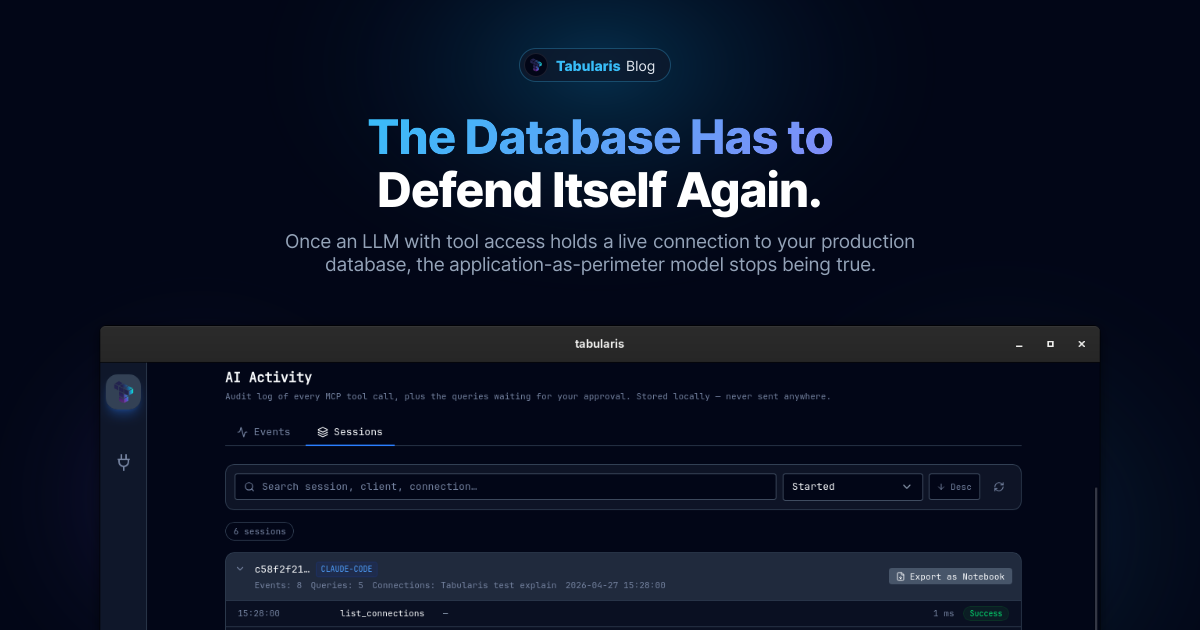
The Database Has to Defend Itself Again

For two decades the database could outsource trust to the application layer. Once an LLM with tool access holds a live connection to production, that proxy is gone — the database has to defend itself again.

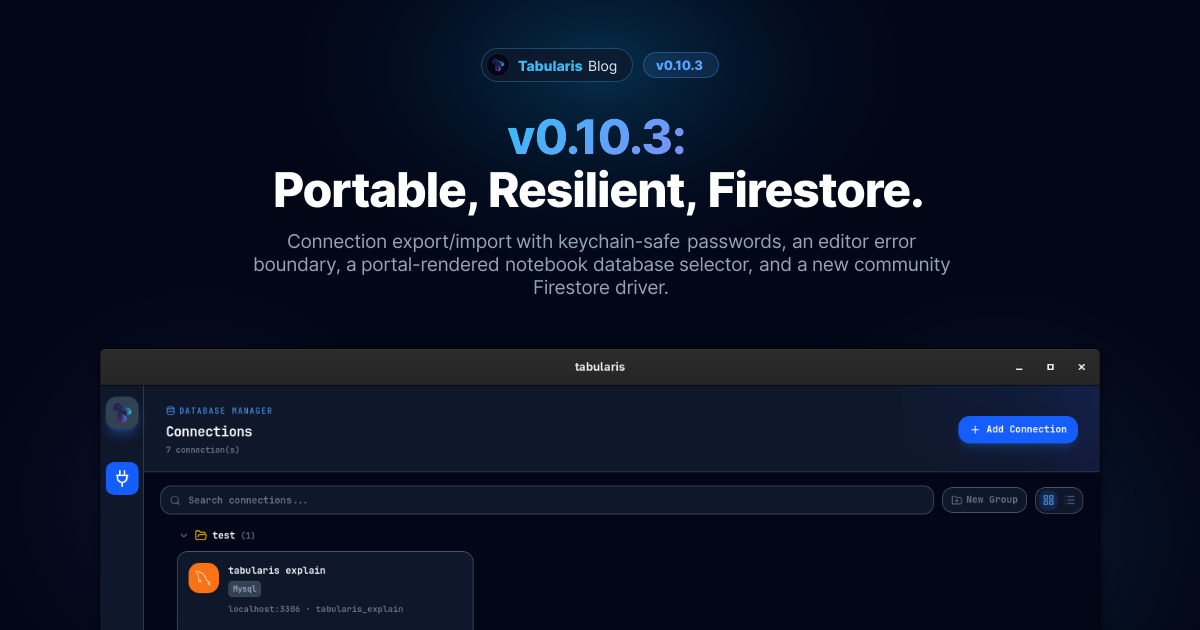
v0.10.3: Portable Connections, an Editor Error Boundary, and Firestore

v0.10.3 lands JSON-based connection export and import (passwords included, keychain-safe), an editor error boundary that keeps the workspace alive when a driver crashes the result grid, a portal-rendered notebook database selector, a fix for drivers that return unnamed columns, and a new community-built Firestore plugin.

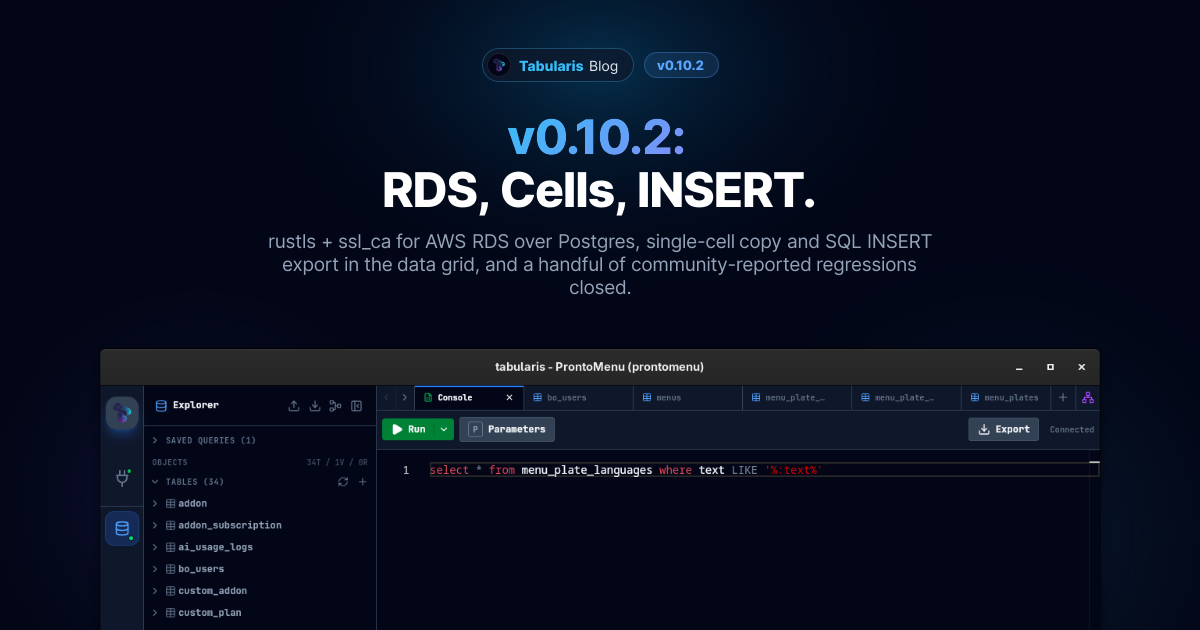
v0.10.2: Postgres on AWS RDS, Cell-Level Copy, and SQL INSERT Export

v0.10.2 fixes a Postgres TLS handshake that broke AWS RDS connections on macOS, lands cell-level selection and SQL INSERT as a copy format in the data grid, restores MySQL passwordless connections, and unbreaks the Manage SSH Connections button.

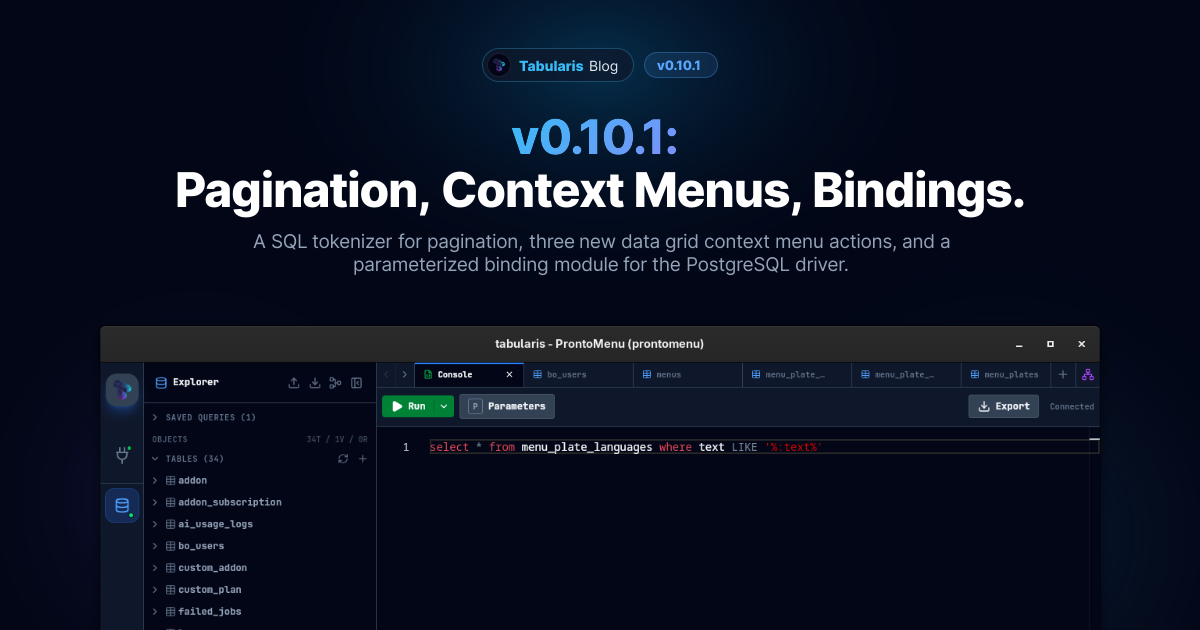
v0.10.1: Pagination Fix, Context Menu Actions, and Postgres Bindings

v0.10.1 is a short follow-up to v0.10.0: a sneaky LIMIT bug in SQL pagination gets a proper SQL tokenizer, the data grid gains multi-row deletion, duplicate row and insert-current-time actions, and the PostgreSQL driver moves to a parameterized binding module.

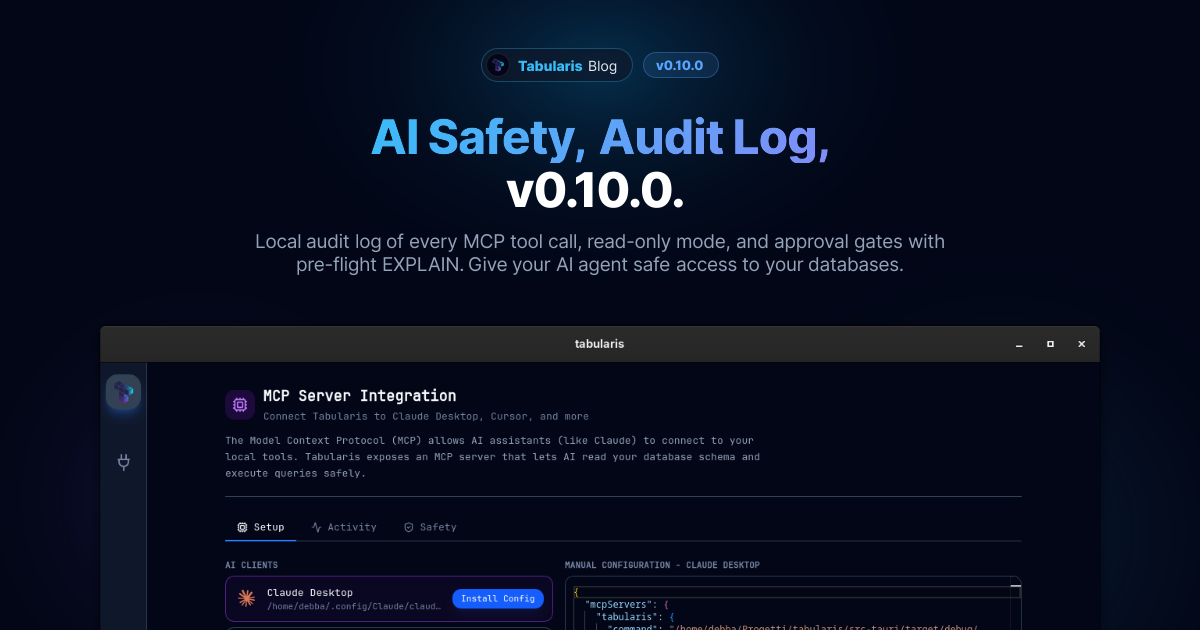
AI Safety, Audit Log and Approval Gates: v0.10.0

v0.10.0 ships an AI audit log, MCP read-only mode, and approval gates with pre-flight EXPLAIN preview. Built around a 200-line file-queue between two processes.

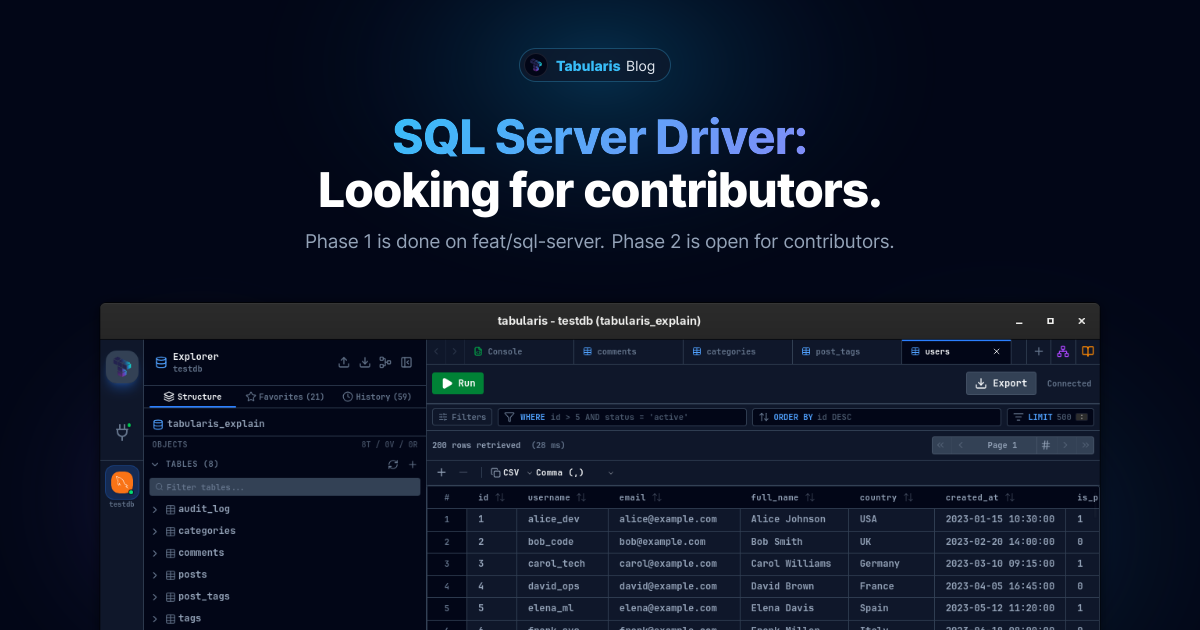
SQL Server Driver: Looking for Contributors

Native Microsoft SQL Server as a built-in driver, now on the feat/sql-server branch as a read-only preview. Phase 2 is open and needs contributors for editing, TLS options and composite primary keys.

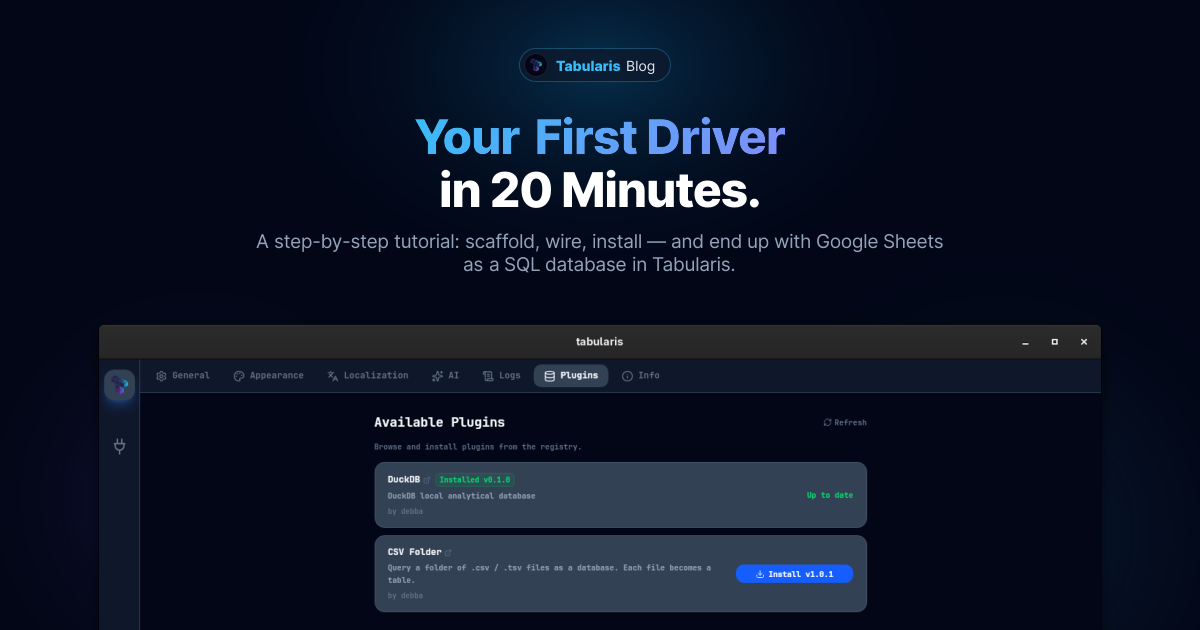
Your First Tabularis Driver in 20 Minutes: Google Sheets, Step by Step

A hands-on walkthrough of @tabularis/create-plugin and @tabularis/plugin-api — from an empty directory to a working Google Sheets driver with OAuth, custom connection form, and sheets-as-SQL tables.

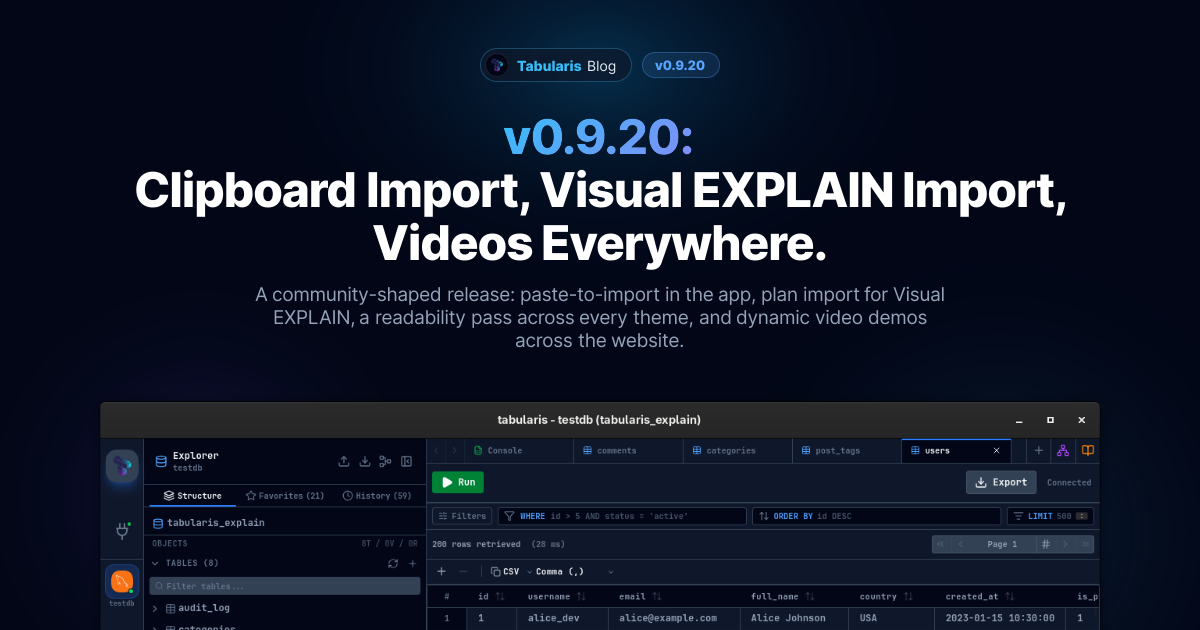
v0.9.20: Clipboard Import, Visual EXPLAIN Import, and a Community Look & Feel

v0.9.20 is a community-shaped release: clipboard data import lands in the app, Visual EXPLAIN gains import support for existing plans, every built-in theme gets a readability pass, and the website goes from static screenshots to dynamic video demos across the hero, wiki, and feature pages.

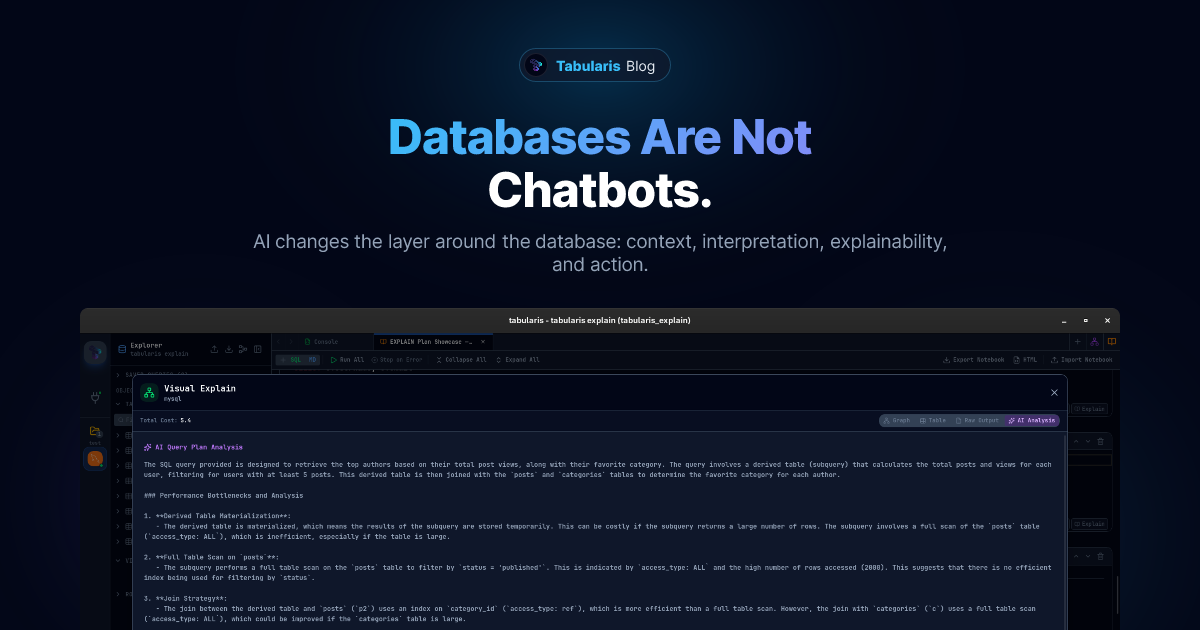
Databases Are Not Becoming Chatbots

AI is not replacing databases. What is changing is the layer around them: context, interpretation, explainability, notebooks, agents, and the workflows that connect them.

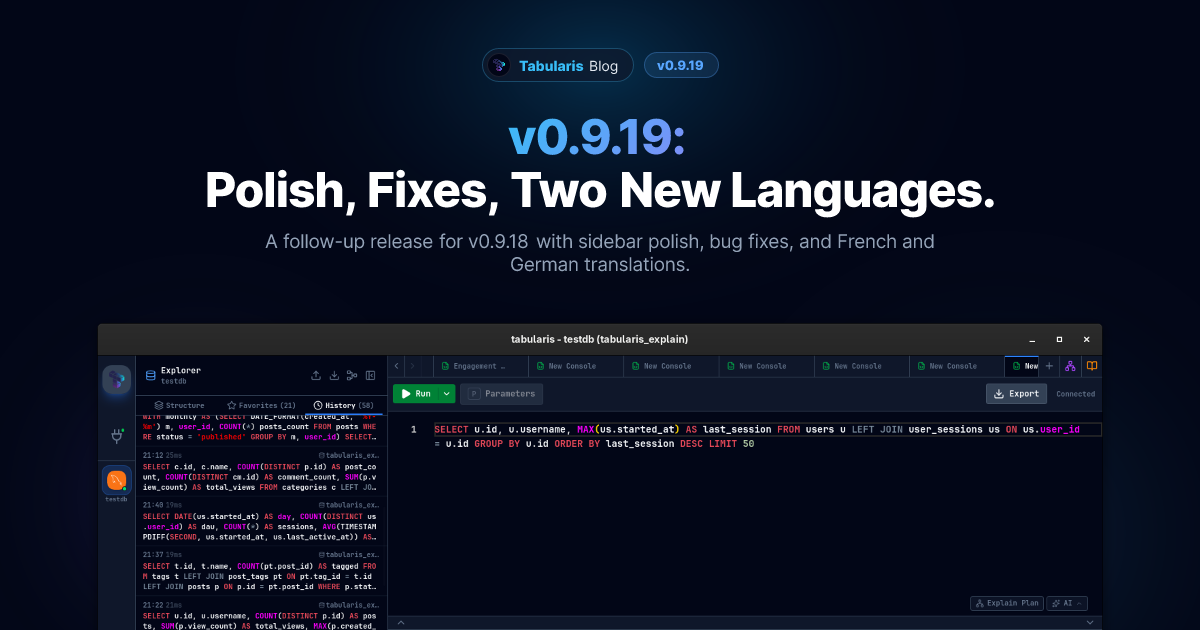
v0.9.19: Polish, Bug Fixes, French and German

v0.9.19 is a short follow-up to v0.9.18: a round of UI polish and bug fixes on top of the new History workflow, plus two new locales — French and German — bringing the UI to six languages.

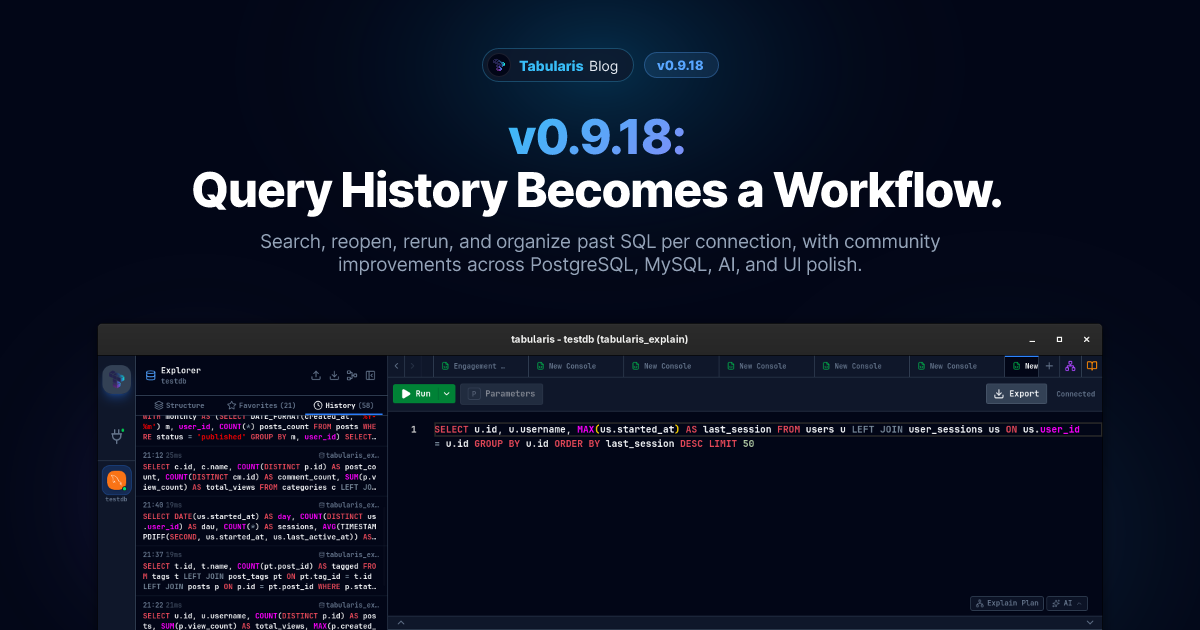
v0.9.18: Query History Becomes a Workflow

v0.9.18 adds a real query history workflow to Tabularis: per-connection storage, search, date grouping, fast re-run actions, and retention controls. The release also includes a strong set of community-driven improvements across PostgreSQL, MySQL, AI settings, and theming.

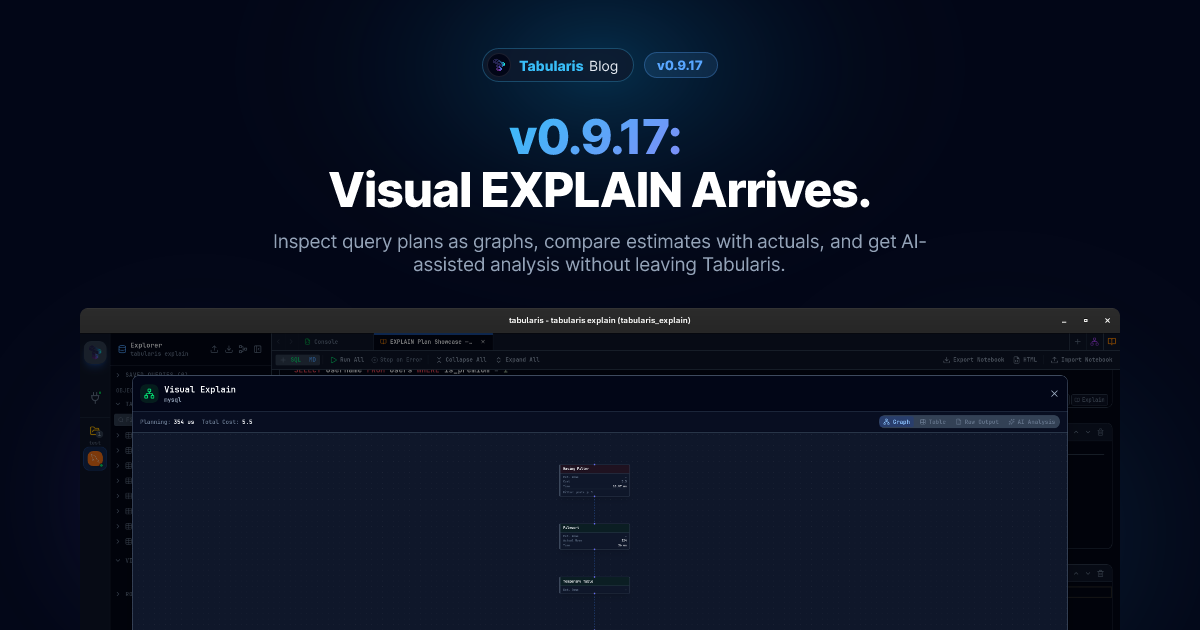
v0.9.17: Visual EXPLAIN Arrives

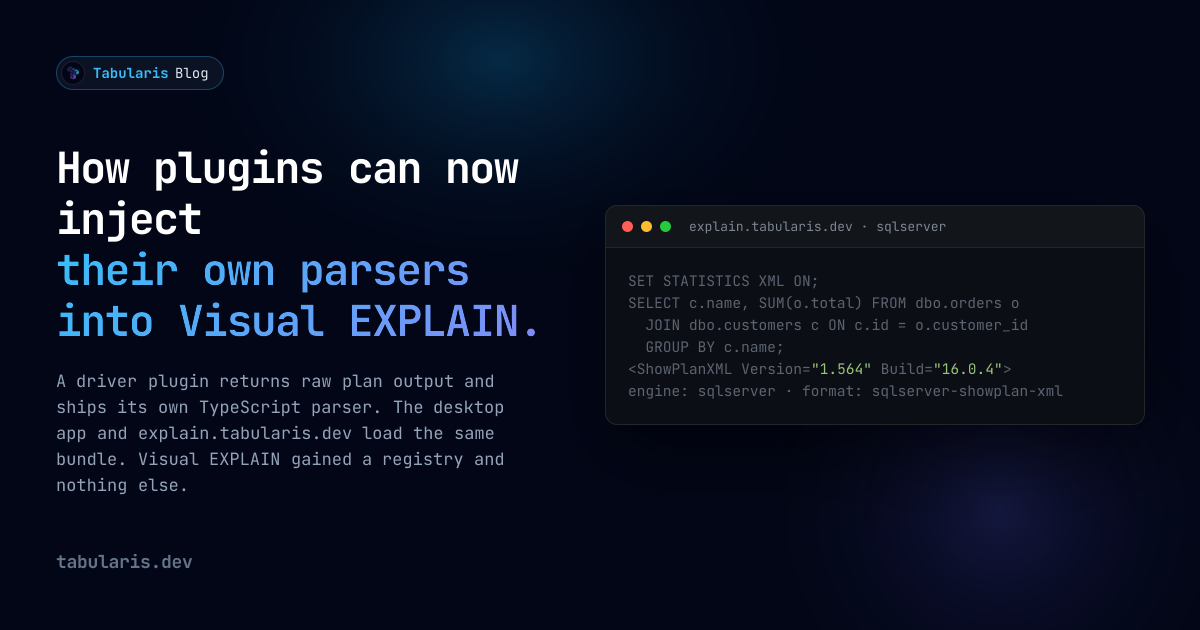
v0.9.17 brings Visual EXPLAIN to Tabularis: interactive execution plan graphs, table and raw views, AI-assisted analysis, and cross-database support for PostgreSQL, MySQL, MariaDB, and SQLite.

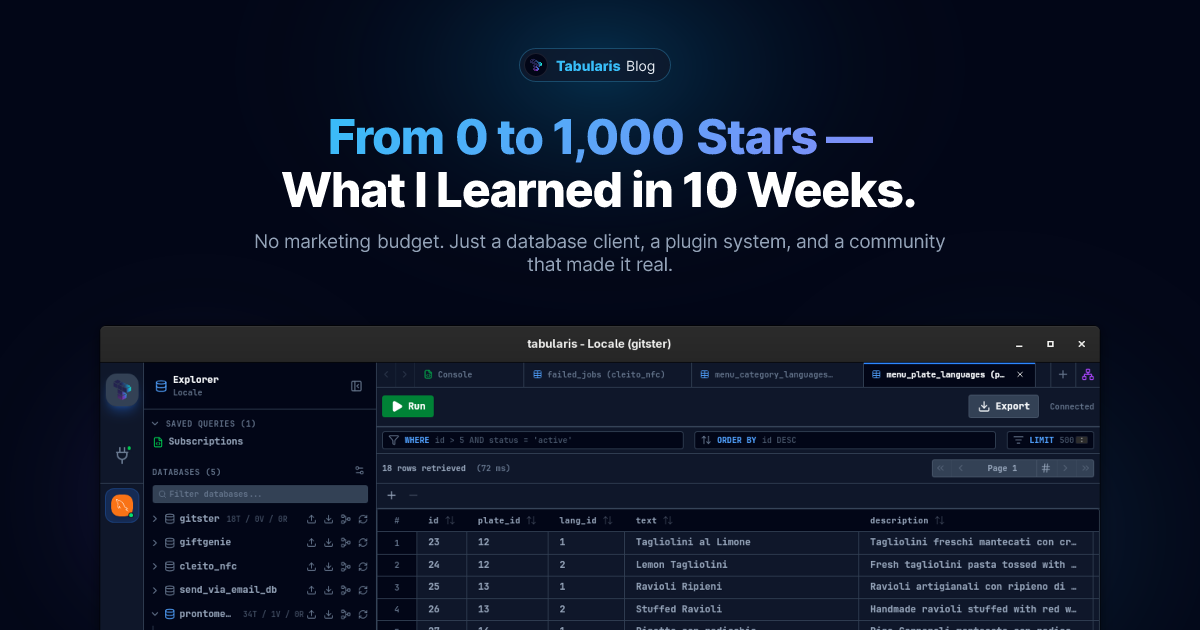
From 0 to 1,000 GitHub Stars: What I Learned in 10 Weeks

Tabularis crossed 1,000 GitHub stars in under three months. No marketing team, no growth hacks. Just a useful tool and a community that showed up. Here's what actually worked, what didn't, and what I'd do differently.

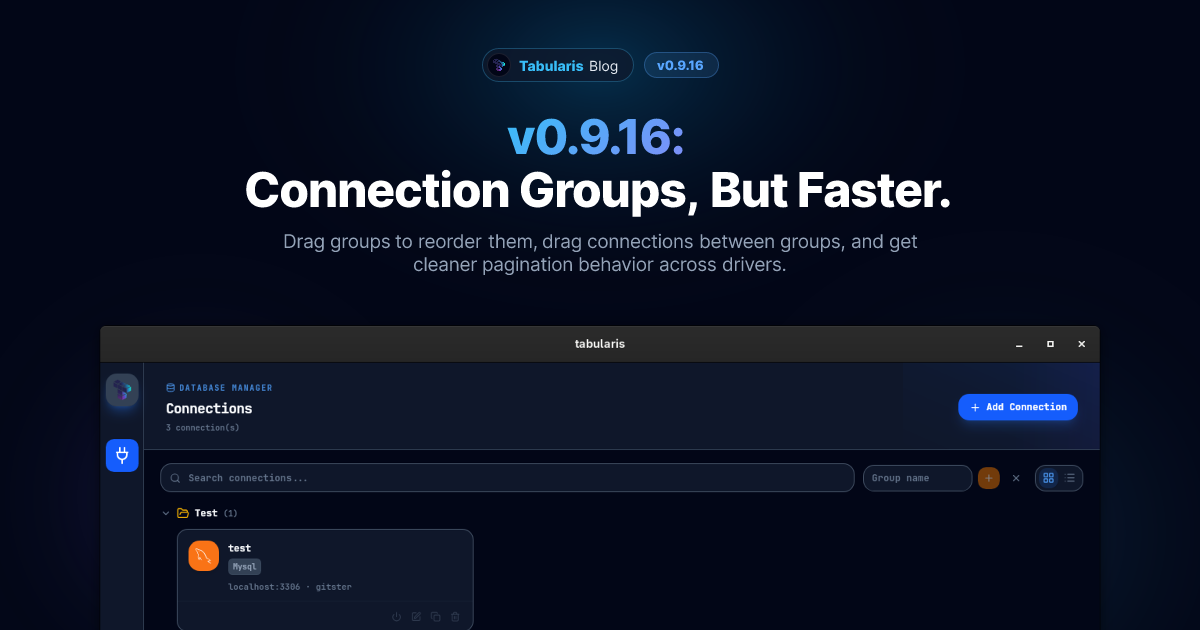
v0.9.16: Connection Groups, But Faster

v0.9.16 makes connection groups feel much more direct: drag groups to reorder them, drag connections into a different group, and get more consistent pagination behavior across built-in drivers.

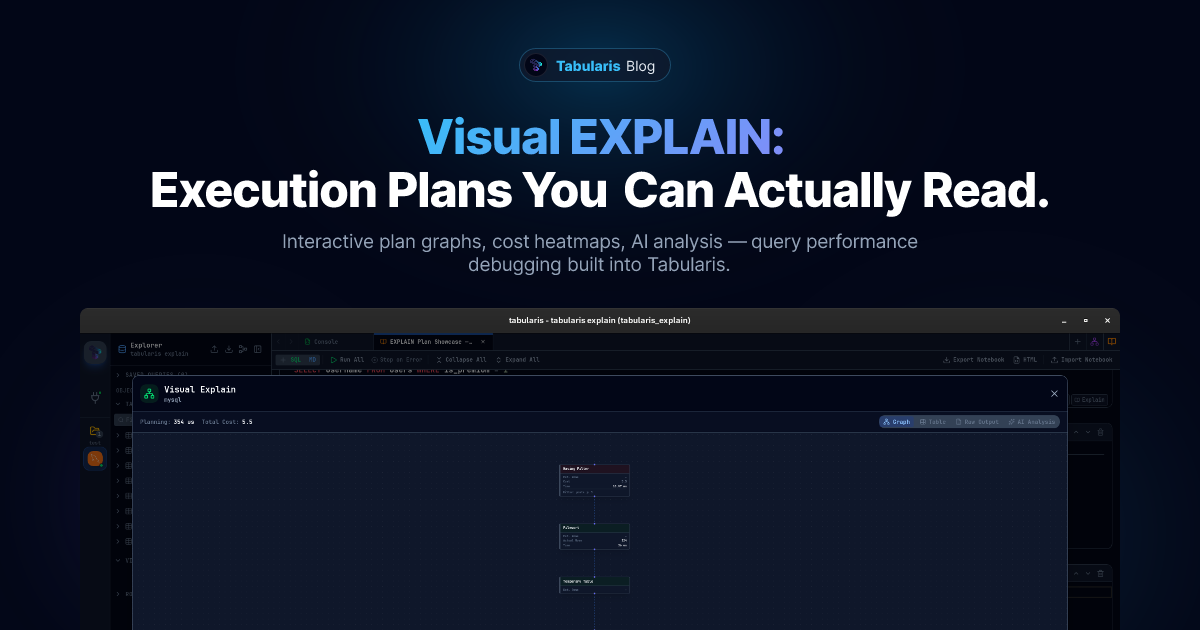
Visual EXPLAIN: Execution Plans You Can Actually Read

A preview of Visual EXPLAIN in Tabularis — interactive execution plan graphs, tabular breakdowns, raw JSON output, and AI-powered analysis. Works with PostgreSQL, MySQL, MariaDB, and SQLite. Still in development, with PostgreSQL as the primary focus.

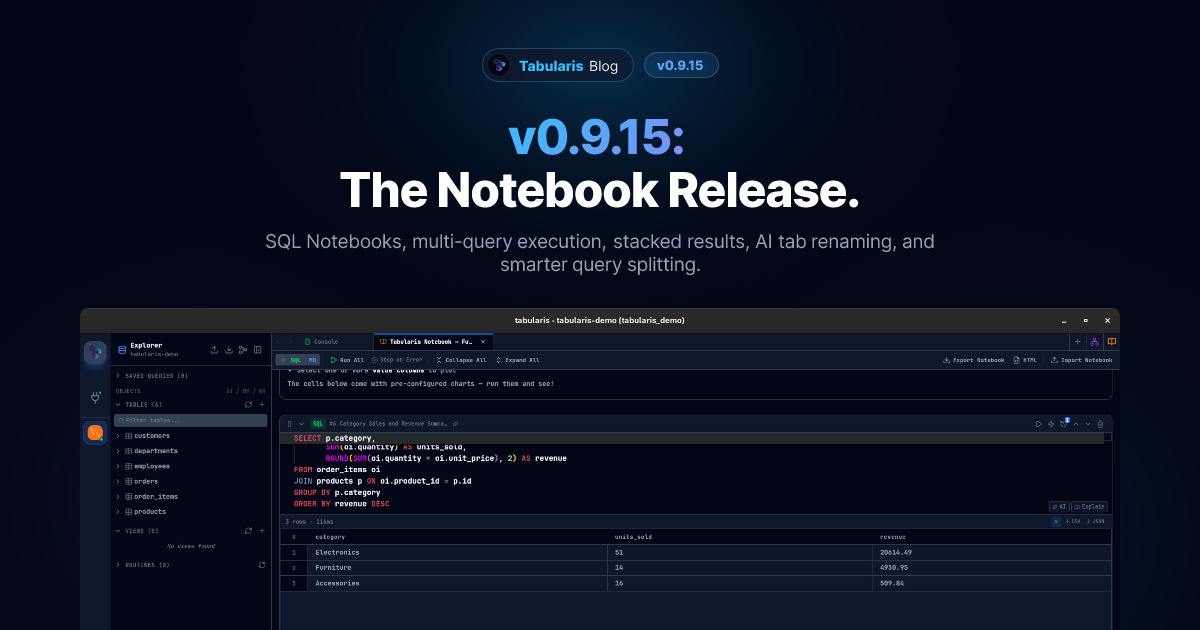
v0.9.15: The Notebook Release

SQL Notebooks land with cell references, inline charts, parameters, AI naming, and HTML export. The query editor gains multi-query execution with tabbed and stacked results, AI-powered tab renaming, and query splitting gets a proper parser.

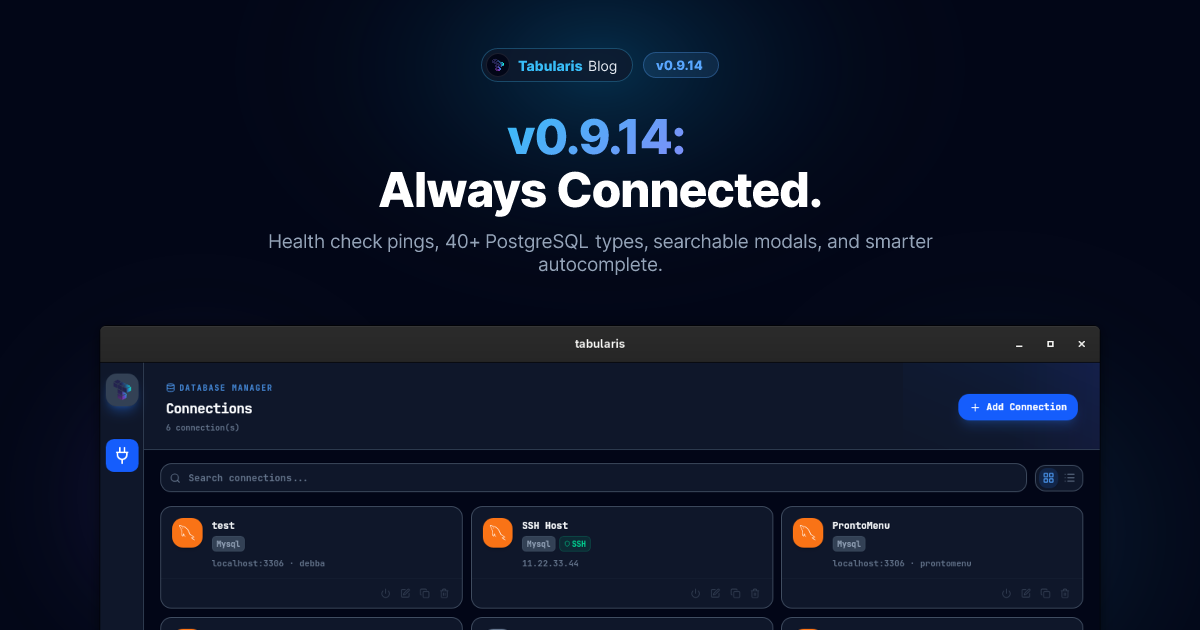
v0.9.14: Always Connected

Connection health monitoring lands, PostgreSQL gains 40+ new types from network to geometry, modals get a searchable type picker and keyboard navigation, and autocompletion finally respects multi-database contexts.

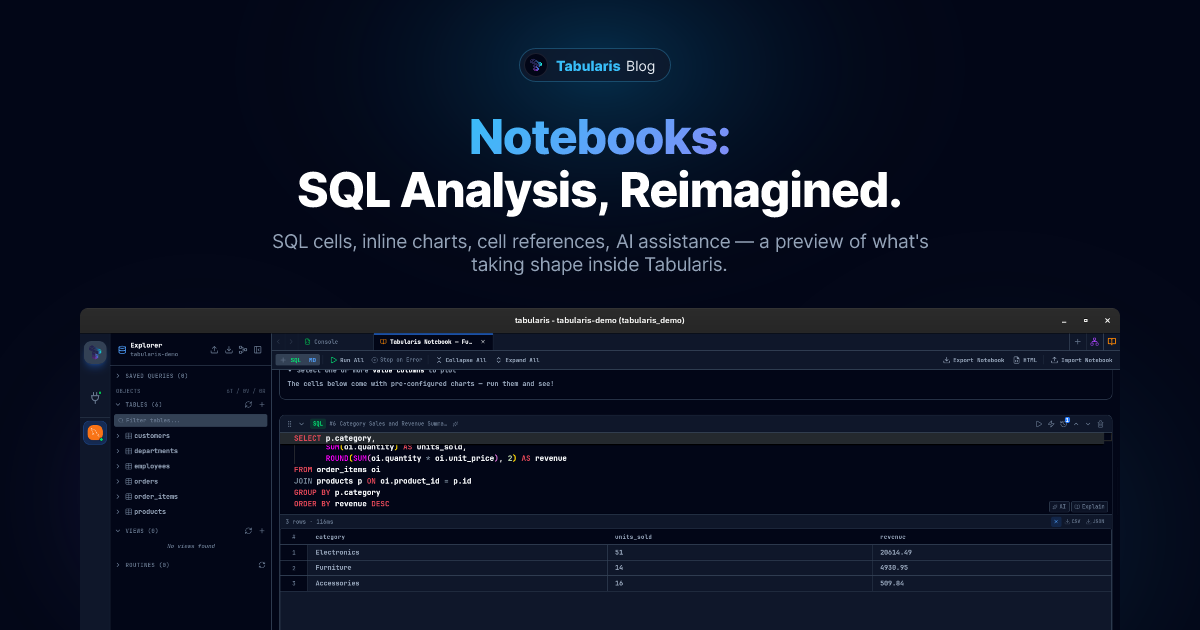
Notebooks: SQL Analysis, Reimagined

A look at what's coming: a full notebook environment inside Tabularis — SQL and markdown cells, inline charts, cell references, parameters, parallel execution, and AI assistance. Still in development, but the shape is clear.

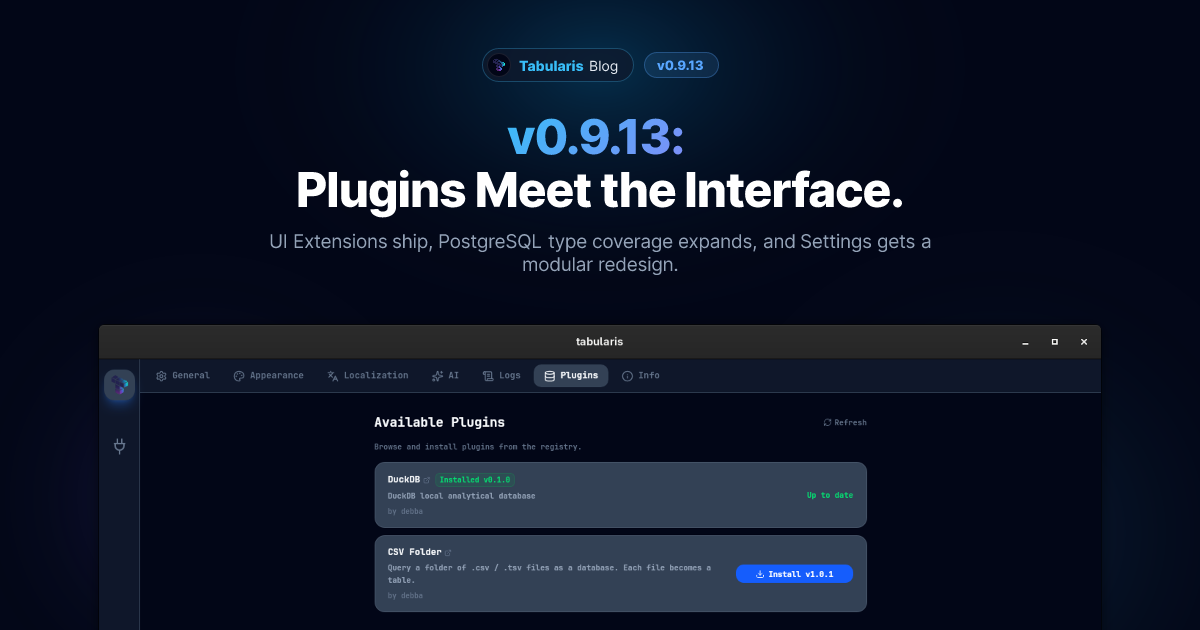
v0.9.13: Plugins Meet the Interface

UI Extensions land in production, PostgreSQL gains range, multirange, and enum support, and the Settings page gets a full redesign. Plus two new driver capabilities for plugin authors.

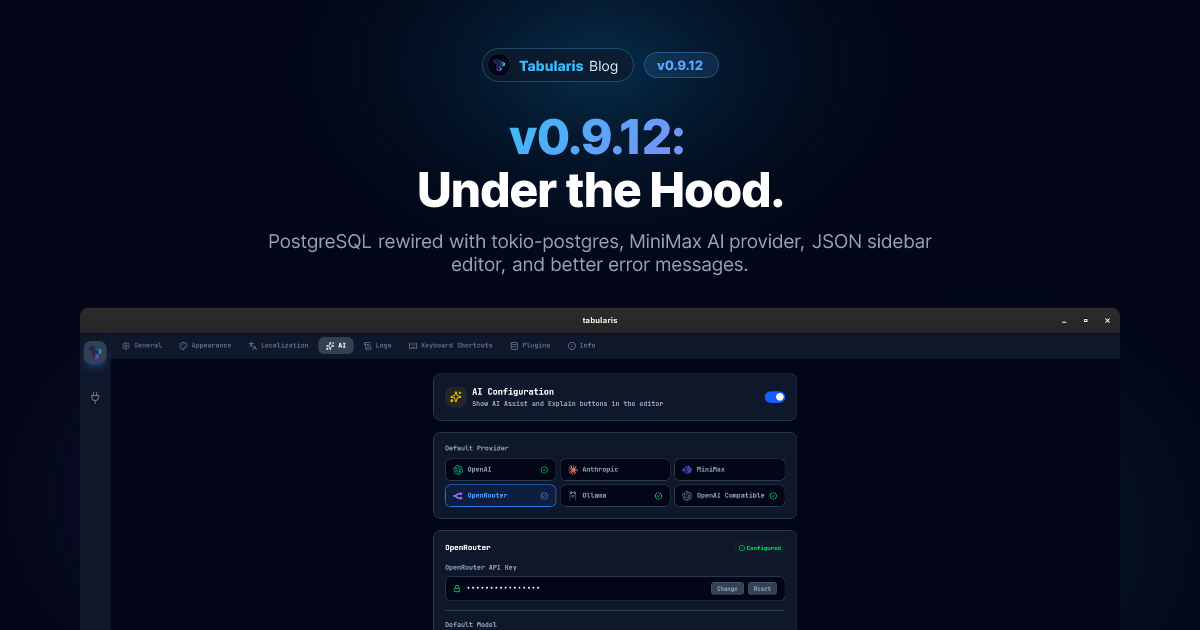
v0.9.12: Under the Hood

The PostgreSQL driver switches from sqlx to tokio-postgres, MiniMax joins the AI providers, JSON columns get a proper editor, and error messages stop being cryptic.

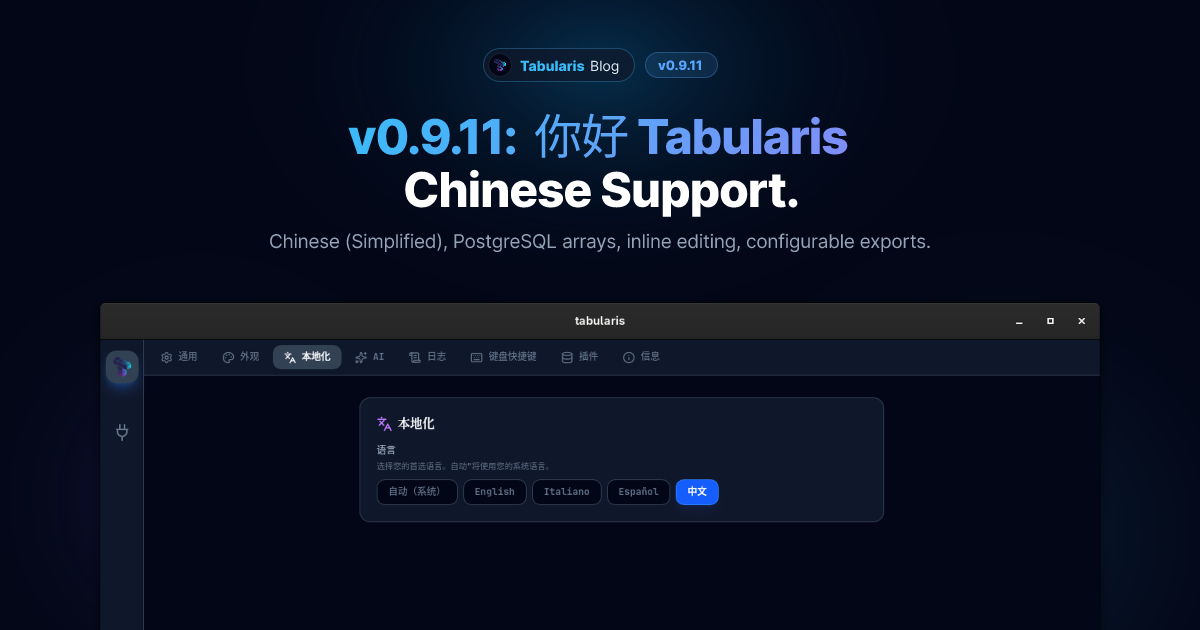
v0.9.11: 你好 Tabularis

Chinese (Simplified) joins the supported languages, PostgreSQL arrays finally work properly, query results are editable inline, and exports got more flexible.

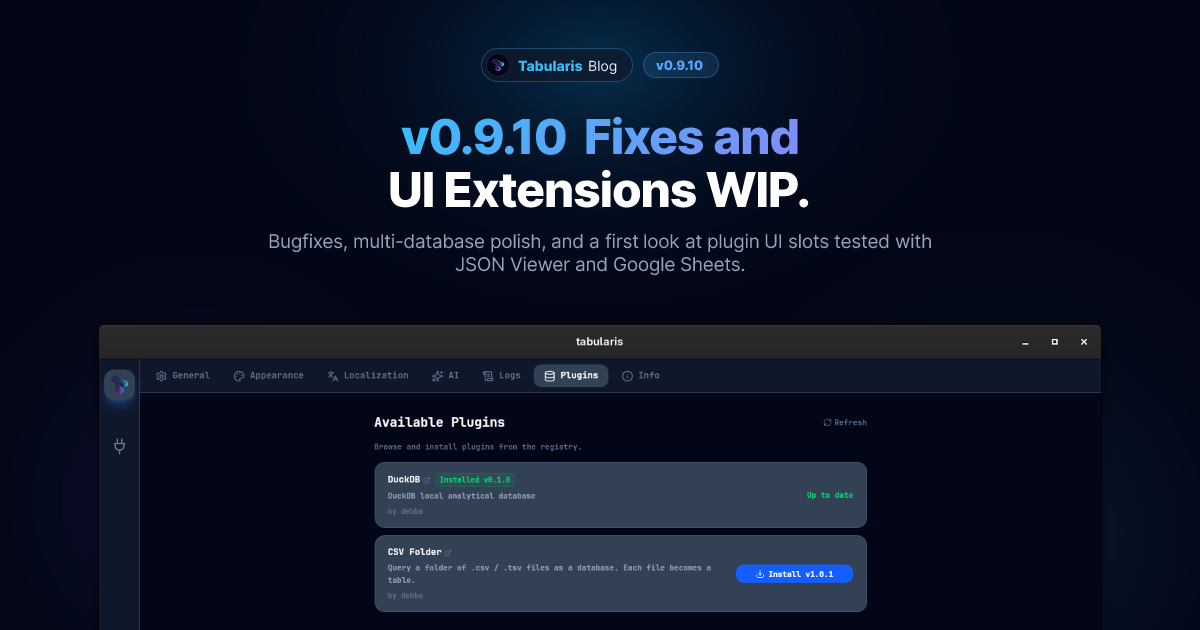
v0.9.10, UI Extensions in Progress, and Two Real Plugins

v0.9.10 lands a handful of fixes, including multi-database window title and per-database record operations. Meanwhile, the UI extensions branch is being tested with two real plugins: a JSON Viewer and the Google Sheets driver.

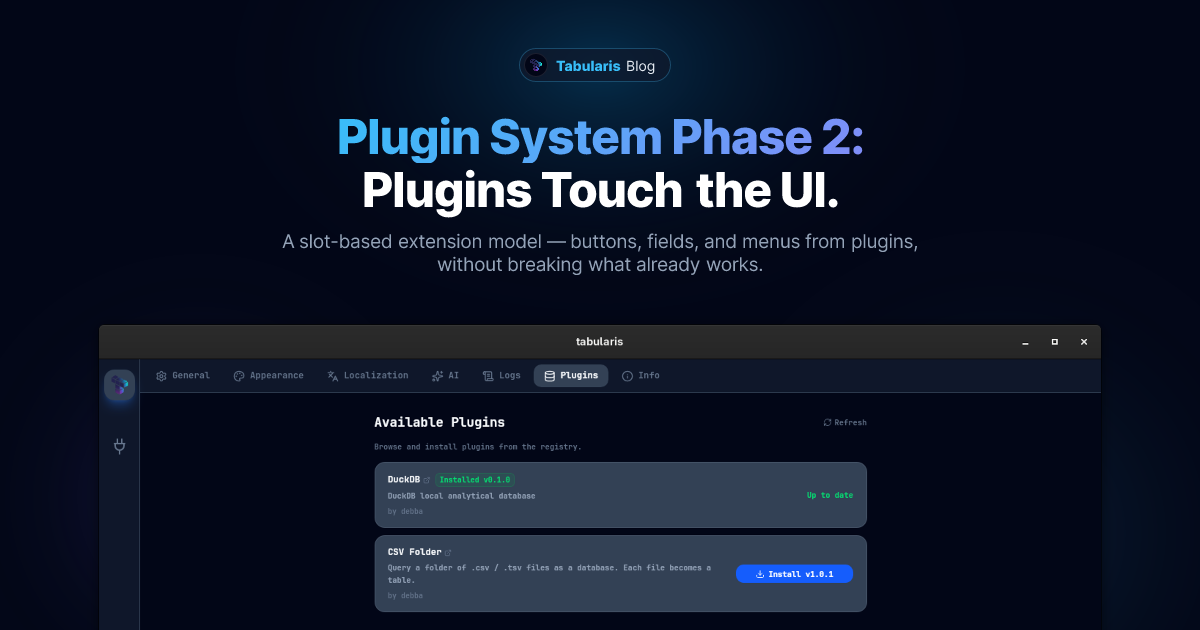
Phase 2 of the Plugin System: Plugins That Touch the UI

Phase 1 let anyone build a database driver. Phase 2 lets plugins put buttons, fields, and menu items directly into the Tabularis interface. Here is the design and why it works the way it does.

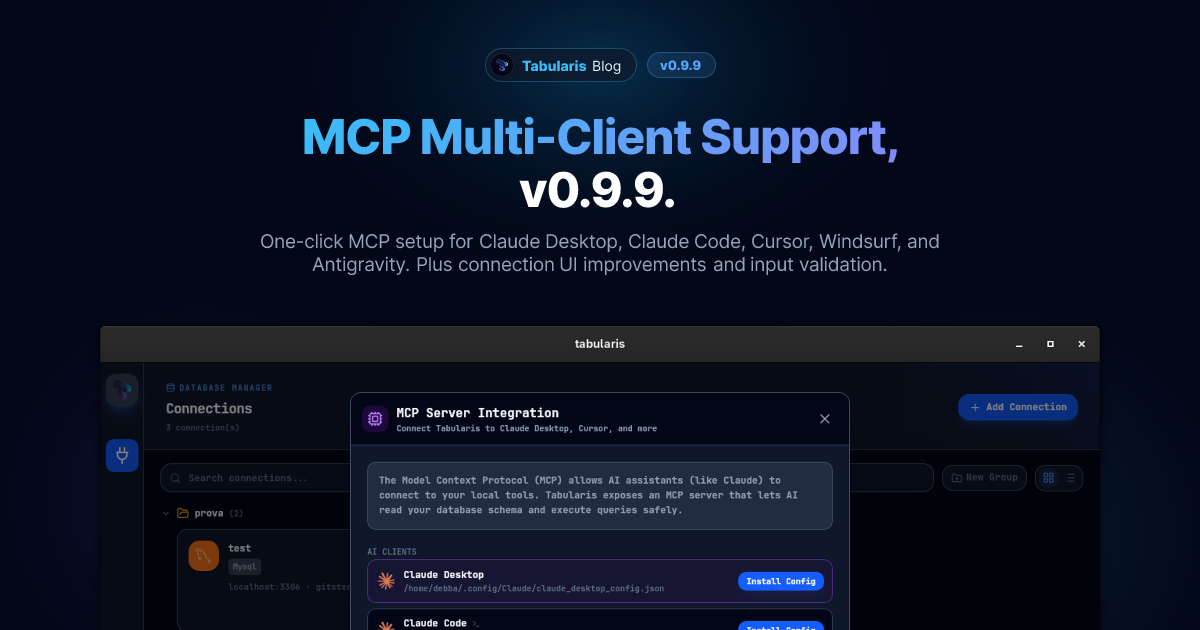
MCP Multi-Client Support and Connection Improvements: v0.9.9

v0.9.9 brings a major MCP upgrade: one-click install for Claude Desktop, Claude Code, Cursor, Windsurf, and Antigravity — plus connection UI polish and input validation.

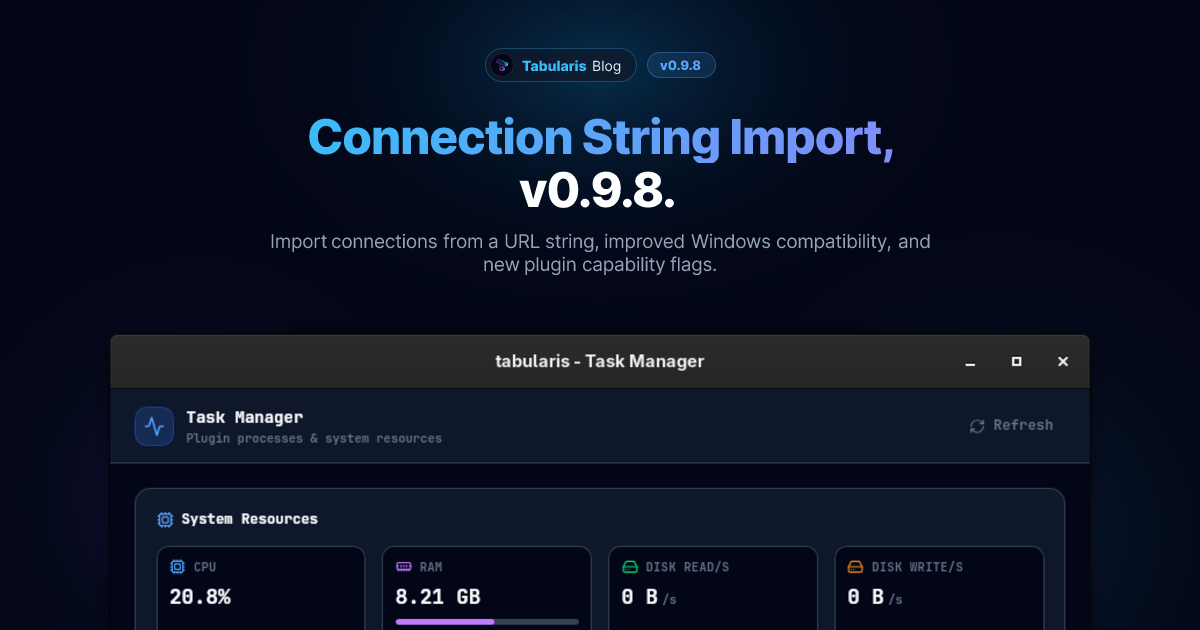
Connection String Import, Visual Query Builder Fix, and More: v0.9.8

v0.9.8 introduces connection string import for network drivers, fixes drag-and-drop in the Visual Query Builder on Windows, and resolves an SQLite open failure on Windows.

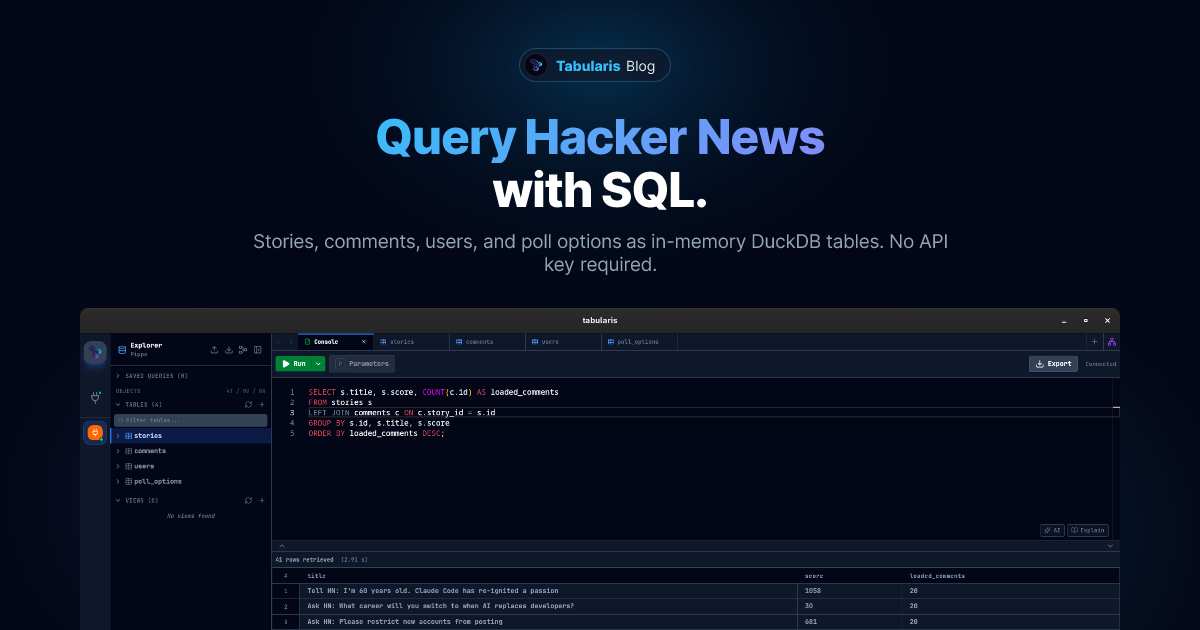
Query Hacker News with SQL: a New Plugin for Tabularis

A Hacker News plugin for Tabularis that exposes the public HN API as a queryable SQL database — and serves as a real-world showcase for the new per-plugin settings system.

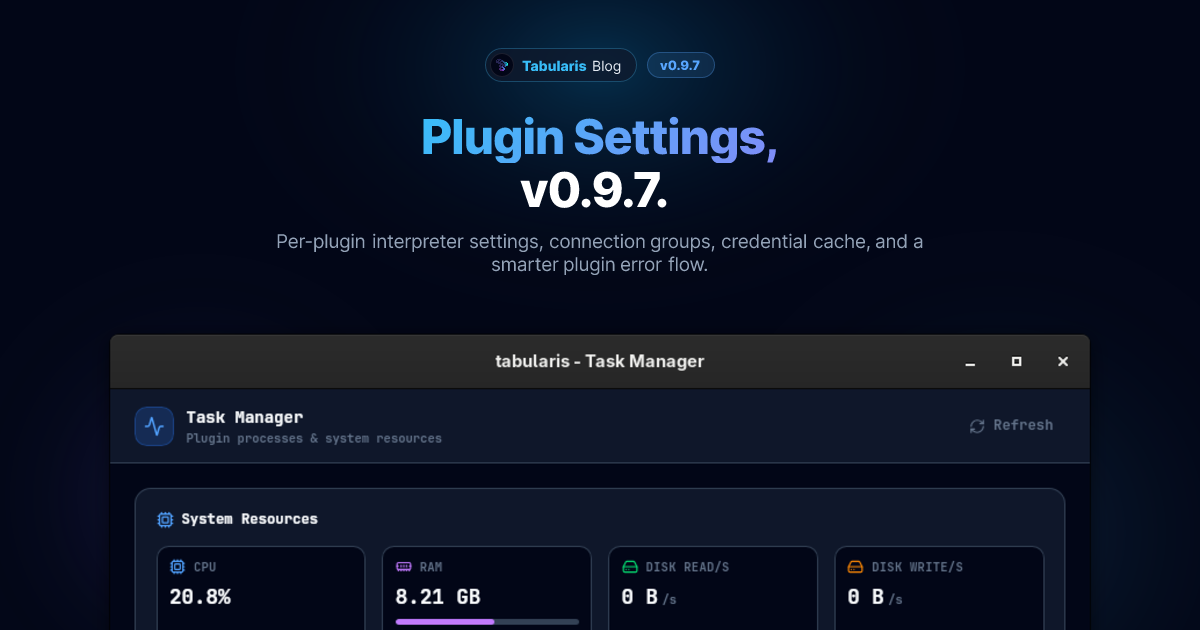
Plugin Settings, Connection Groups, and Credential Cache: v0.9.7

v0.9.7 brings per-plugin interpreter settings, connection groups, a credential cache, and a robust plugin startup error flow.

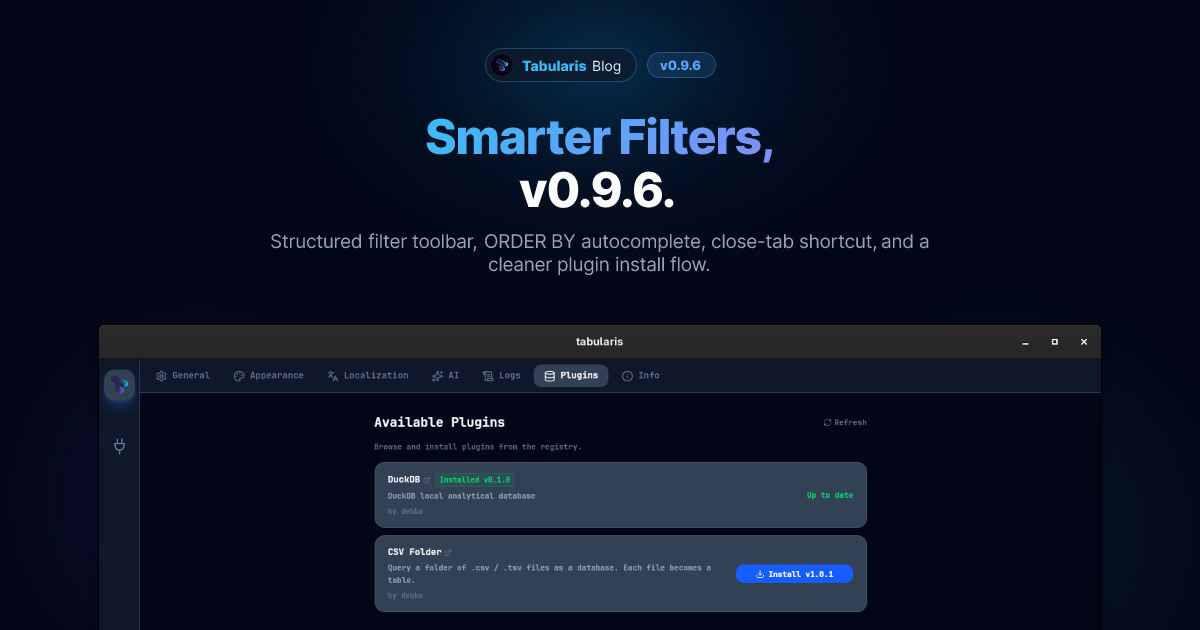
Smarter Filters, Close Tab, and a Better Plugin Install: v0.9.6

v0.9.6 ships a structured filter toolbar with ORDER BY autocomplete, a close-tab keyboard shortcut, a cleaner plugin install error experience, and a handful of focused bug fixes.

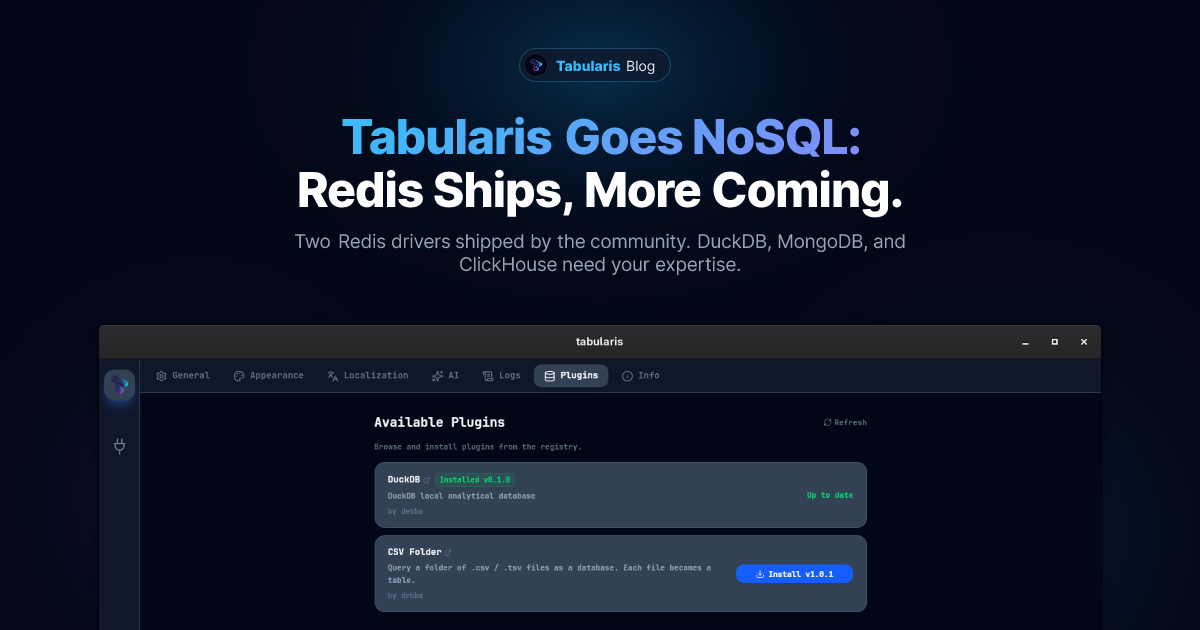
Tabularis Goes NoSQL: Redis Ships, MongoDB and ClickHouse Need You

The plugin ecosystem is growing beyond SQL. Two Redis drivers have already shipped thanks to community contributors. Now we need experts to push DuckDB, MongoDB, and ClickHouse across the finish line.

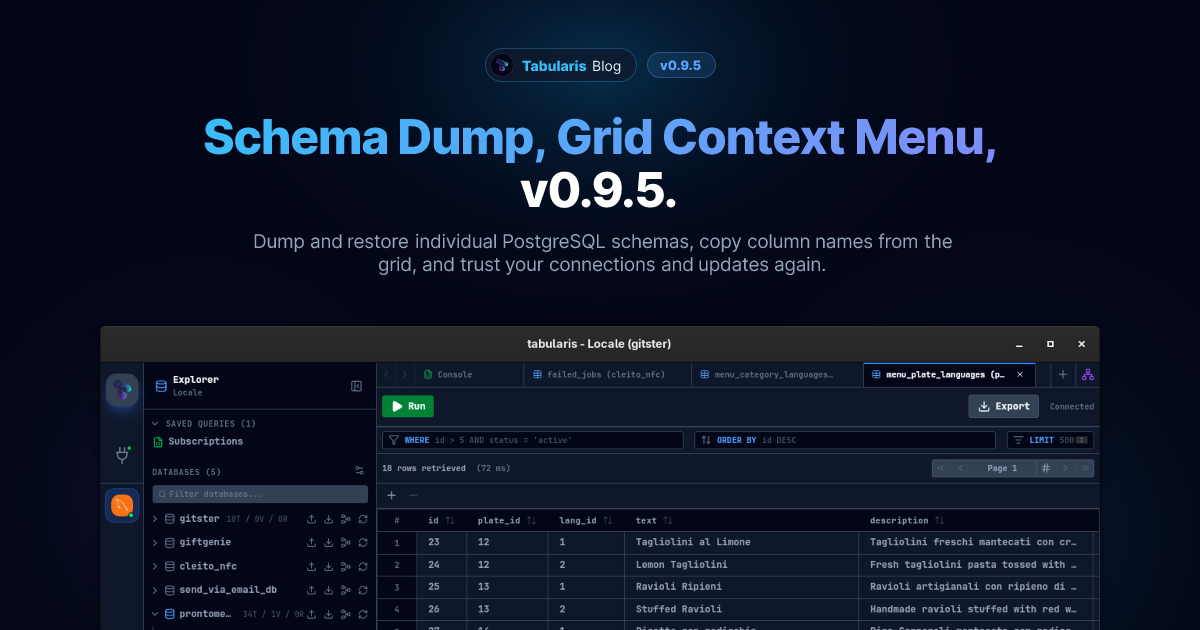
Schema Dump, Grid Context Menu, and Stability Fixes: v0.9.5

v0.9.5 ships schema-aware dump/import for PostgreSQL, a column header context menu in the data grid, and a focused round of stability fixes for MySQL, PostgreSQL, Monaco, and the auto-updater.

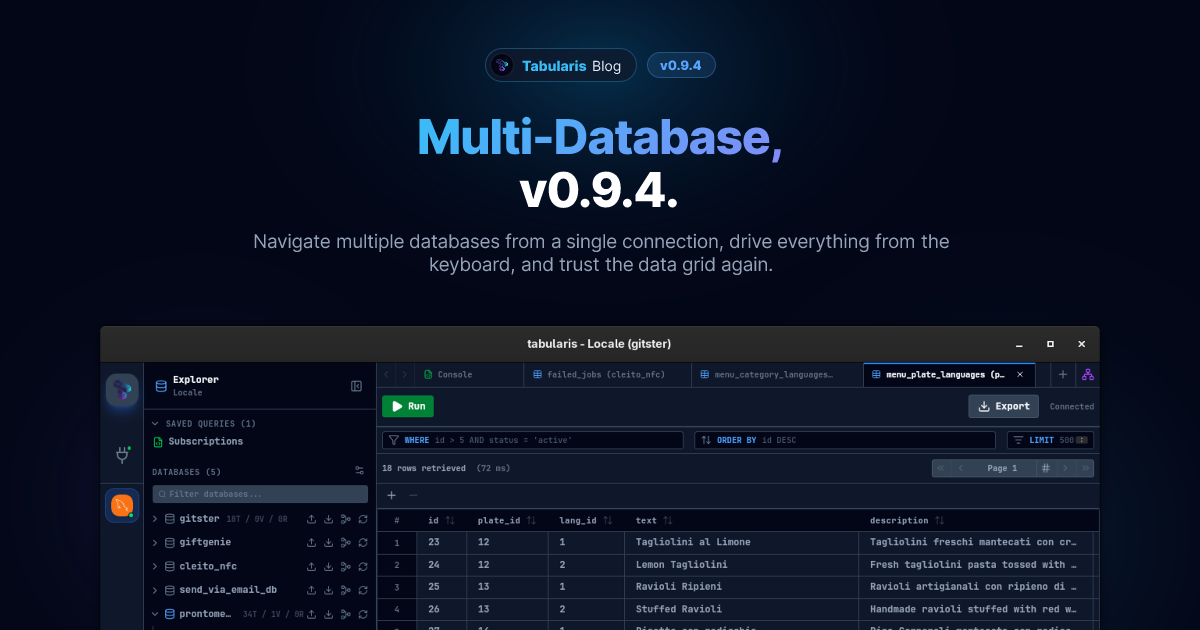
Multi-Database, Shortcuts, and a Cleaner Grid: v0.9.4

v0.9.4 brings a full multi-database sidebar for MySQL, a persistent keyboard shortcuts system with visual hints, a redesigned Connections UI, and several targeted bug fixes.

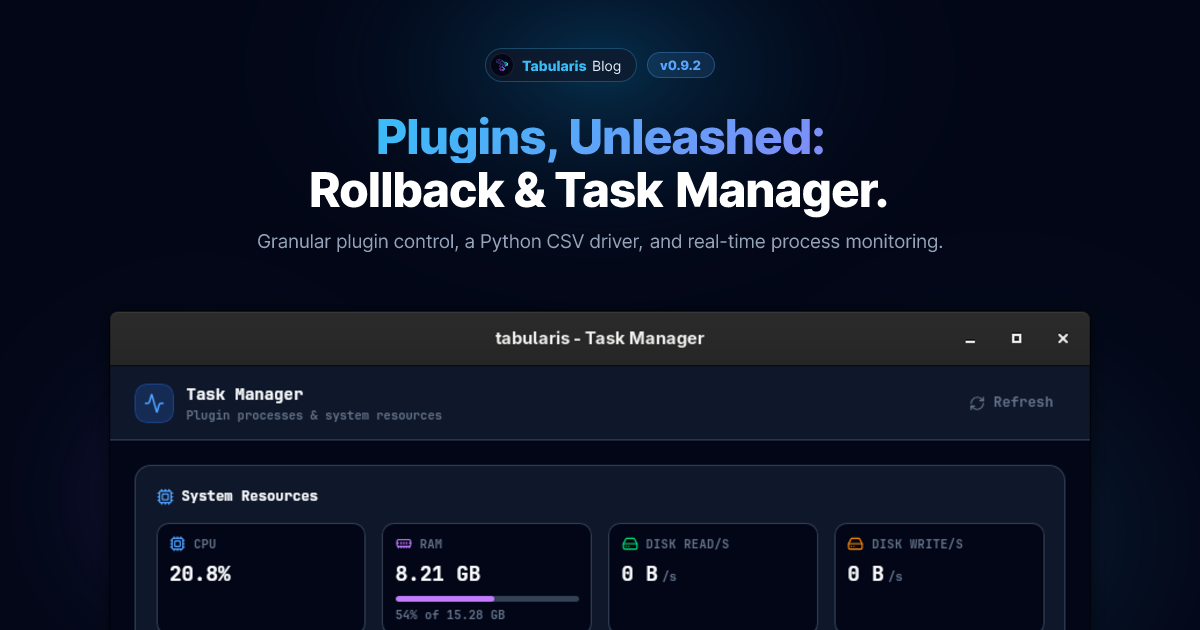
Plugins, Unleashed: Rollback, Python Drivers, and the Task Manager

v0.9.2 brings a fully evolved plugin ecosystem — enable/disable drivers, rollback to previous versions, a cross-platform Python plugin for CSV folders, and a new Task Manager to monitor every process at a glance.

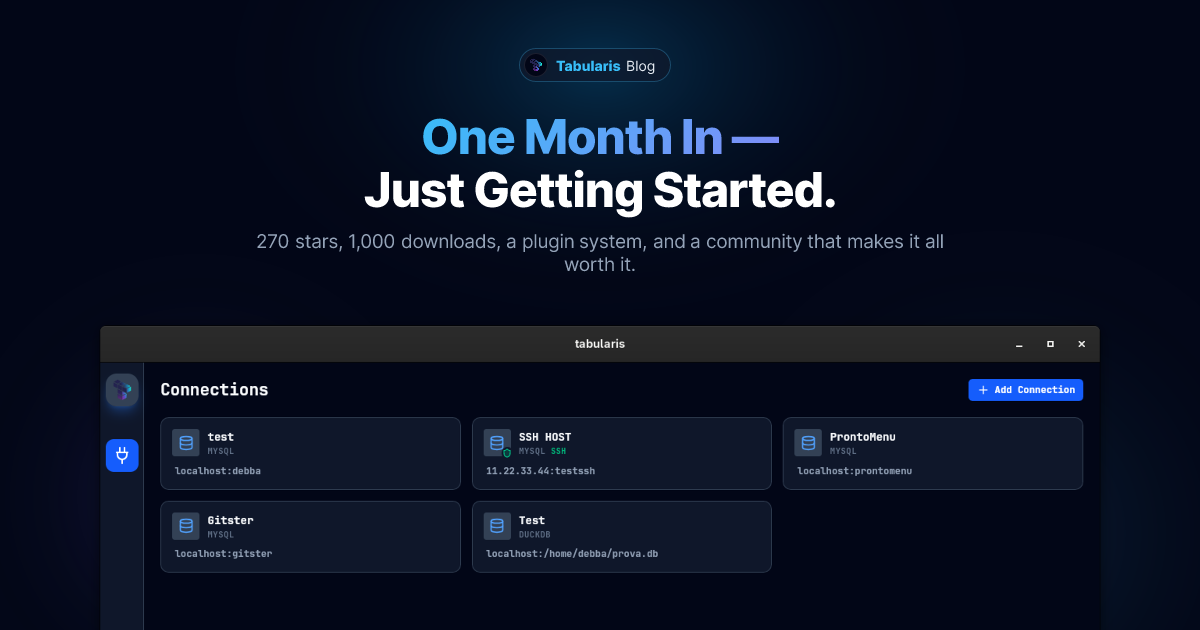
One Month In — and We're Just Getting Started

Tabularis was born on the night of January 25th. Today marks exactly one month. Here's what we built together — and what comes next.

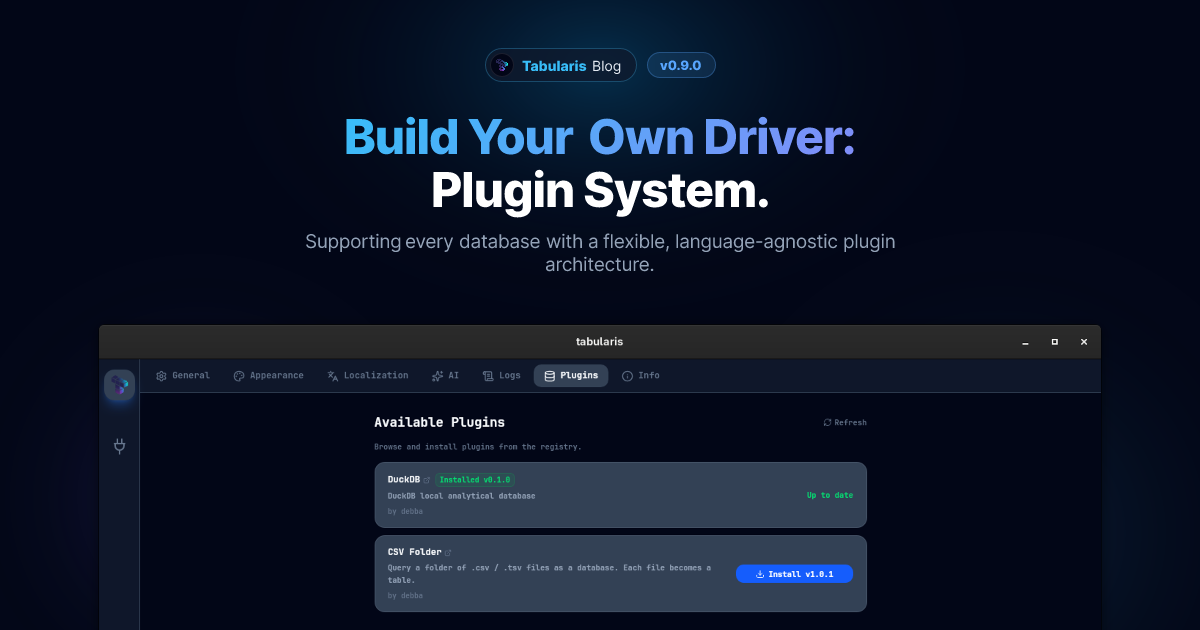
Build Your Own Driver: Tabularis Gets a Plugin System

Supporting every database in the world is an impossible task for a small team. So we built a plugin system that lets anyone add a new database driver — in any language.

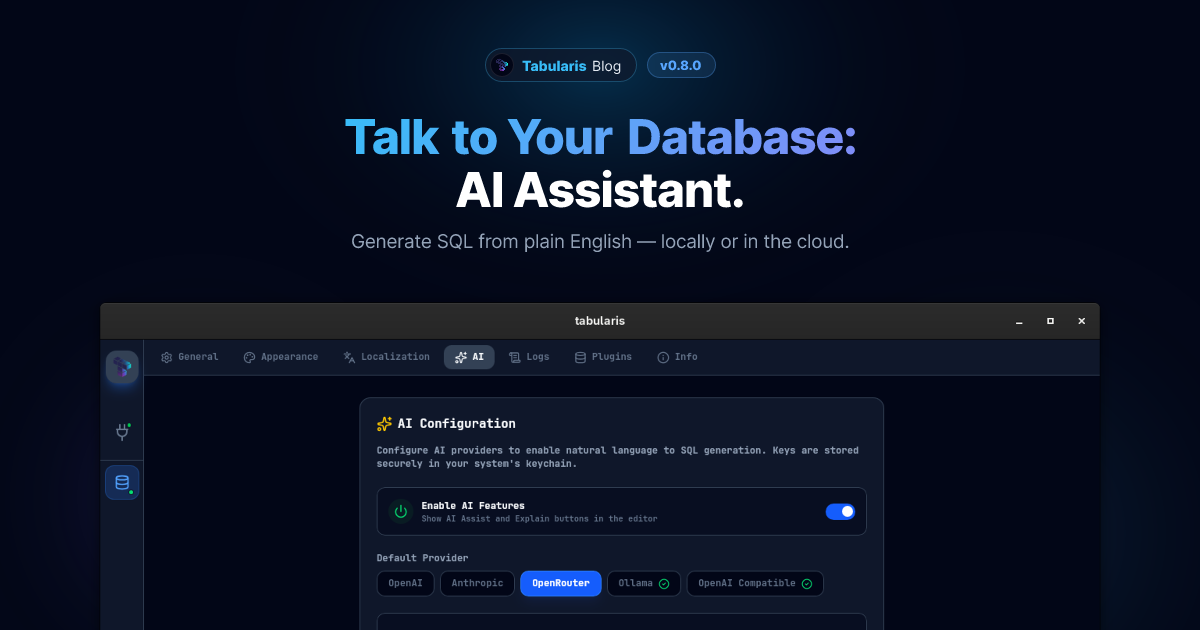
Talk to Your Database: AI Assistant Lands in v0.8.0

Sometimes you know what you want but not exactly how to write the SQL. v0.8.0 brings an AI assistant that generates queries from plain English — locally or in the cloud.

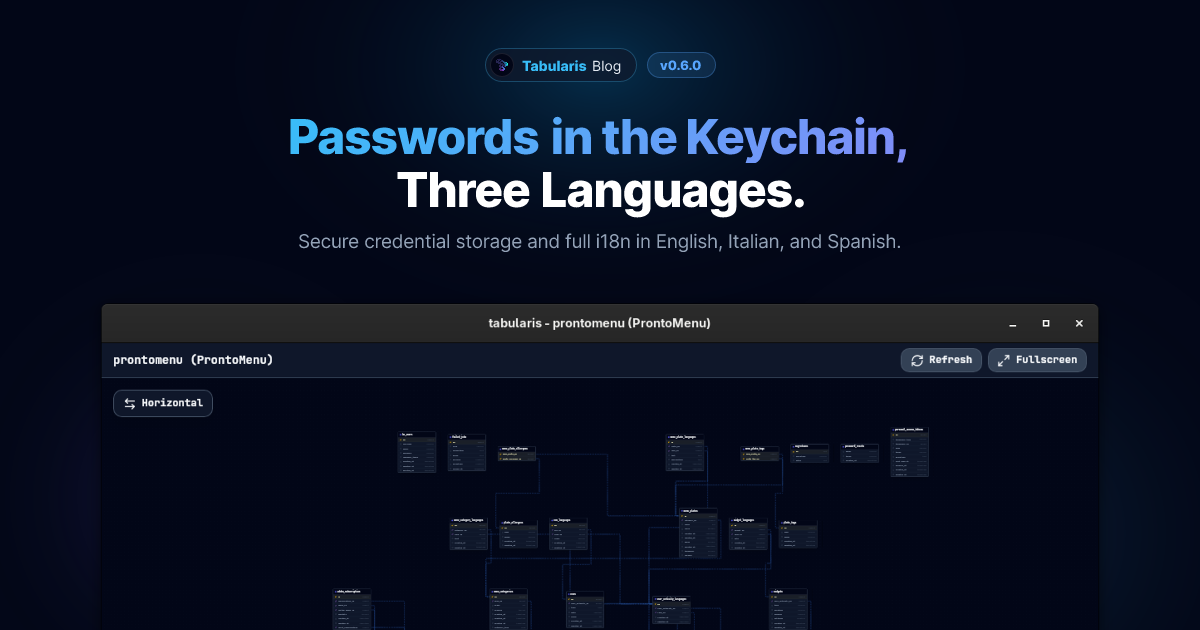
Passwords in the Keychain, Queries in Three Languages

v0.6.0 integrates system keychain storage for credentials and ships the full UI in English, Italian, and Spanish.

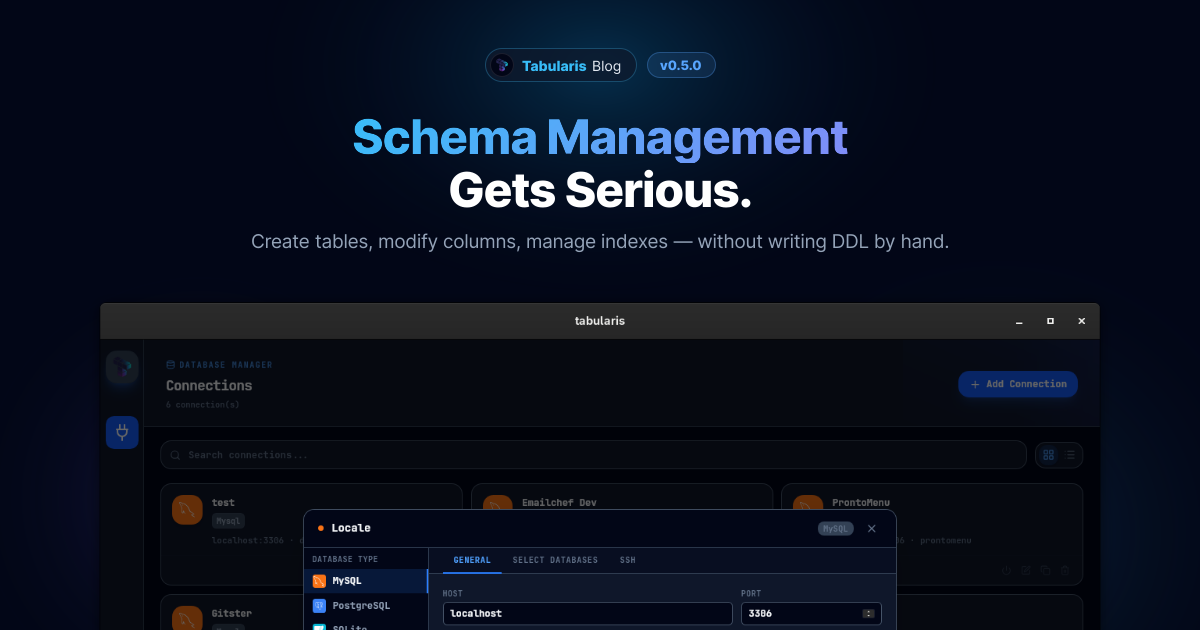
Schema Management Gets Serious

v0.5.0 turns the sidebar into a full schema editor. Create tables, modify columns, manage indexes and foreign keys — all without writing DDL by hand.

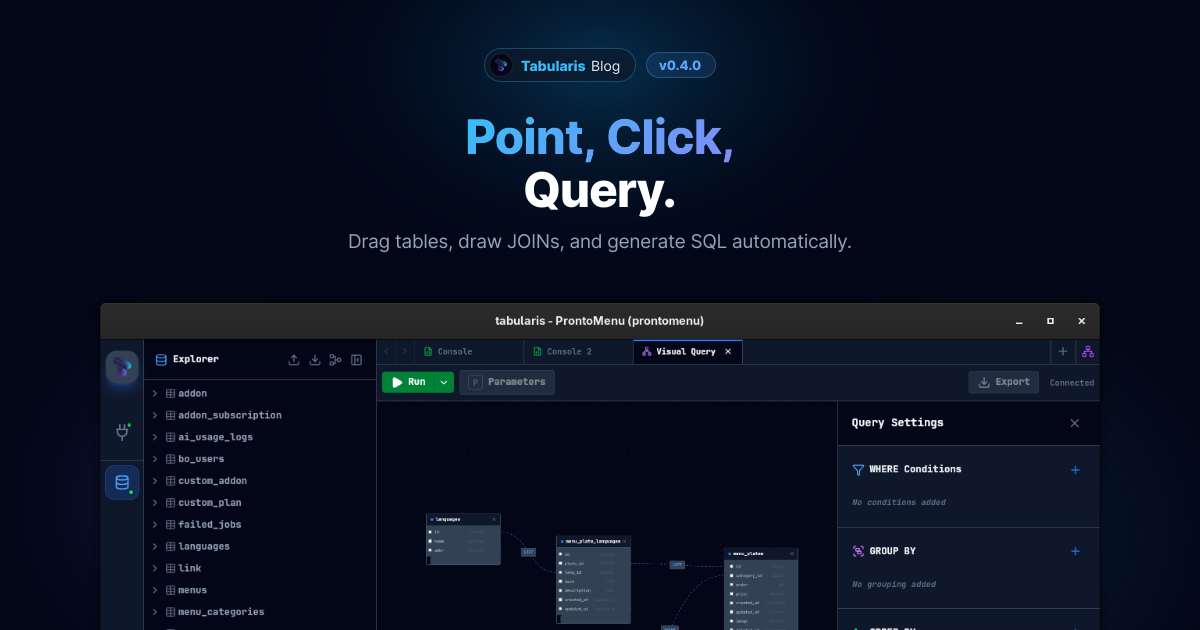
Point, Click, Query: The Visual Query Builder

Not every query needs to be typed from scratch. v0.4.0 ships a Visual Query Builder that lets you drag tables, draw JOINs, and generate SQL automatically.