
v0.19.0: Connections That Know They're Production, Columns That Keep Secrets, and Tables Without a Primary Key You Can Finally Edit

v0.19.0 follows v0.18.0 and is a release about guardrails. The headline teaches connections which environment they belong to — with a permanent red banner and a confirmation before any write while you're on production — and adds free-form colored tags for organizing everything else. The results grid learns to render password, token and email columns as •••••• until you deliberately reveal them. The oldest editing limitation in the data grid falls: tables without a primary key accept cell edits, NULLs and row deletions instead of silently ignoring you. Underneath, the plugin pipeline closes most of its feature gap with the built-in drivers, plugin installs stop being able to clobber a working installation with a corrupt archive, and the Linux AppImage stops shipping the stale libwayland that produced black windows on up-to-date distros.
Tags, Environments, and a Warning Before You Write to Production
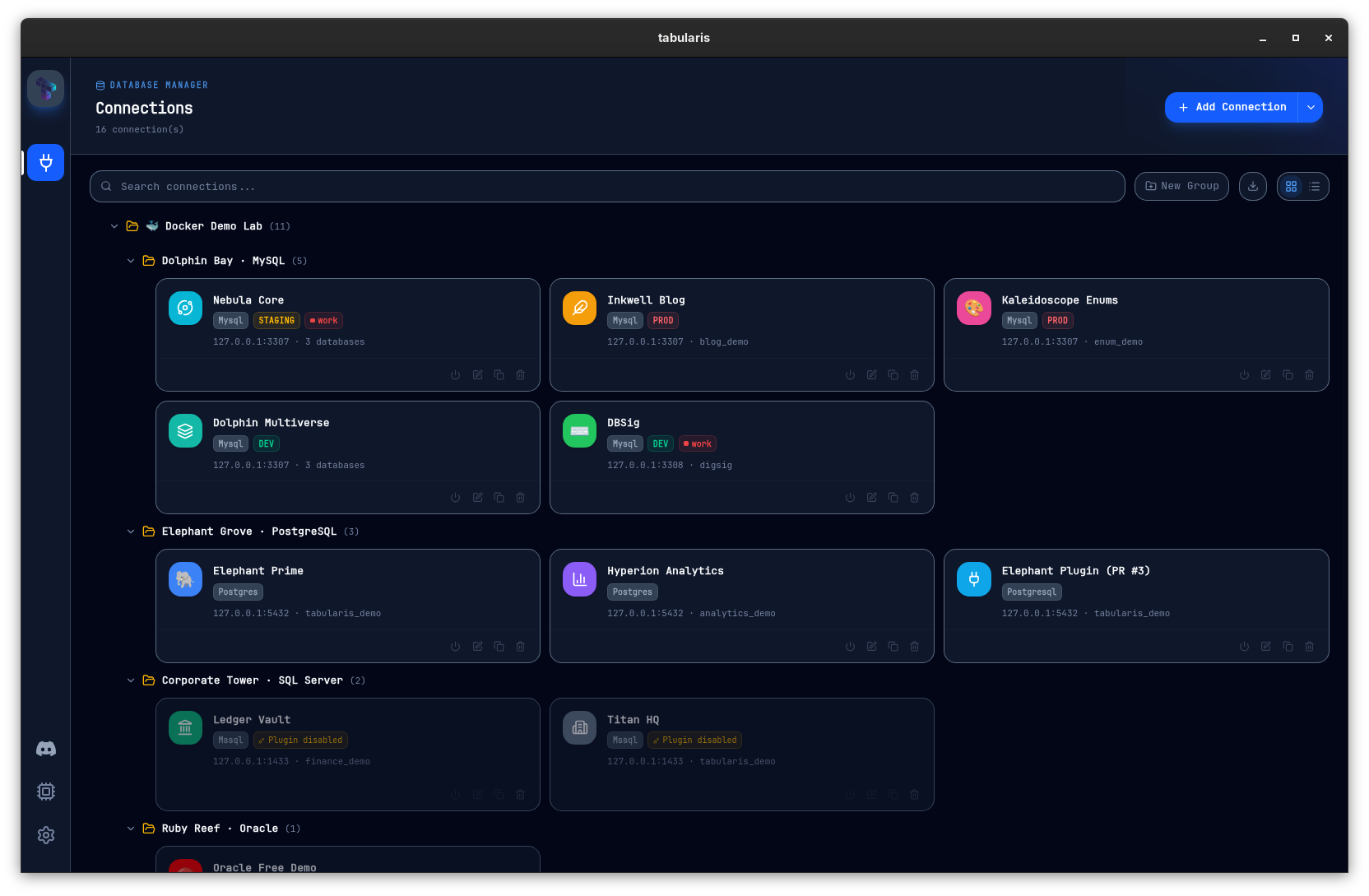
Every connection list eventually turns into a minefield: the local scratch database and the customer-facing one sit two rows apart, distinguished by nothing but a name. PR #473, from @pokertour, closes #472 with two complementary features, following the DBeaver model.
Free-form colored tags. Tags live in connections.json alongside groups; connections carry a list of tag ids. The connection modal's appearance tab gets a tag picker with inline creation on the shared accent palette and a manage mode to rename, recolor or delete. Tags render as colored chips on connection cards and list rows, and tag names participate in the connection search filter. They also ride along in export, import and backups — selective exports only include the tags actually used, and imports merge by id first, then by name, remapping tag_ids onto the existing tag. Re-creating "prod" on another machine never duplicates it.
Environment classification. Each connection can optionally declare itself development, staging or production, picked in the modal title bar and preserved across duplicate and import. Production identity is loud on purpose: a PROD badge on cards and rows, a red ring on open sidebar entries, and a permanent red banner while the active connection is production.
The write guard. Any statement that isn't provably read-only prompts for confirmation on a production connection, with a SQL preview and a per-connection "don't ask again" that lasts for the session. Detection is deliberately conservative — only SELECT, SHOW, DESCRIBE, PRAGMA and EXPLAIN of a SELECT count as read-only. Data-modifying CTEs, EXPLAIN ANALYZE <write> (which executes the write on PostgreSQL) and unknown statement types like CALL or SET all prompt. The guard covers editor runs, staged grid-edit commits, immediate cell edits, row insertion and notebook cells, and it stacks with the destructive-query guard from v0.14.0 rather than replacing it.
Video unavailable
Sensitive Columns Come Up Masked
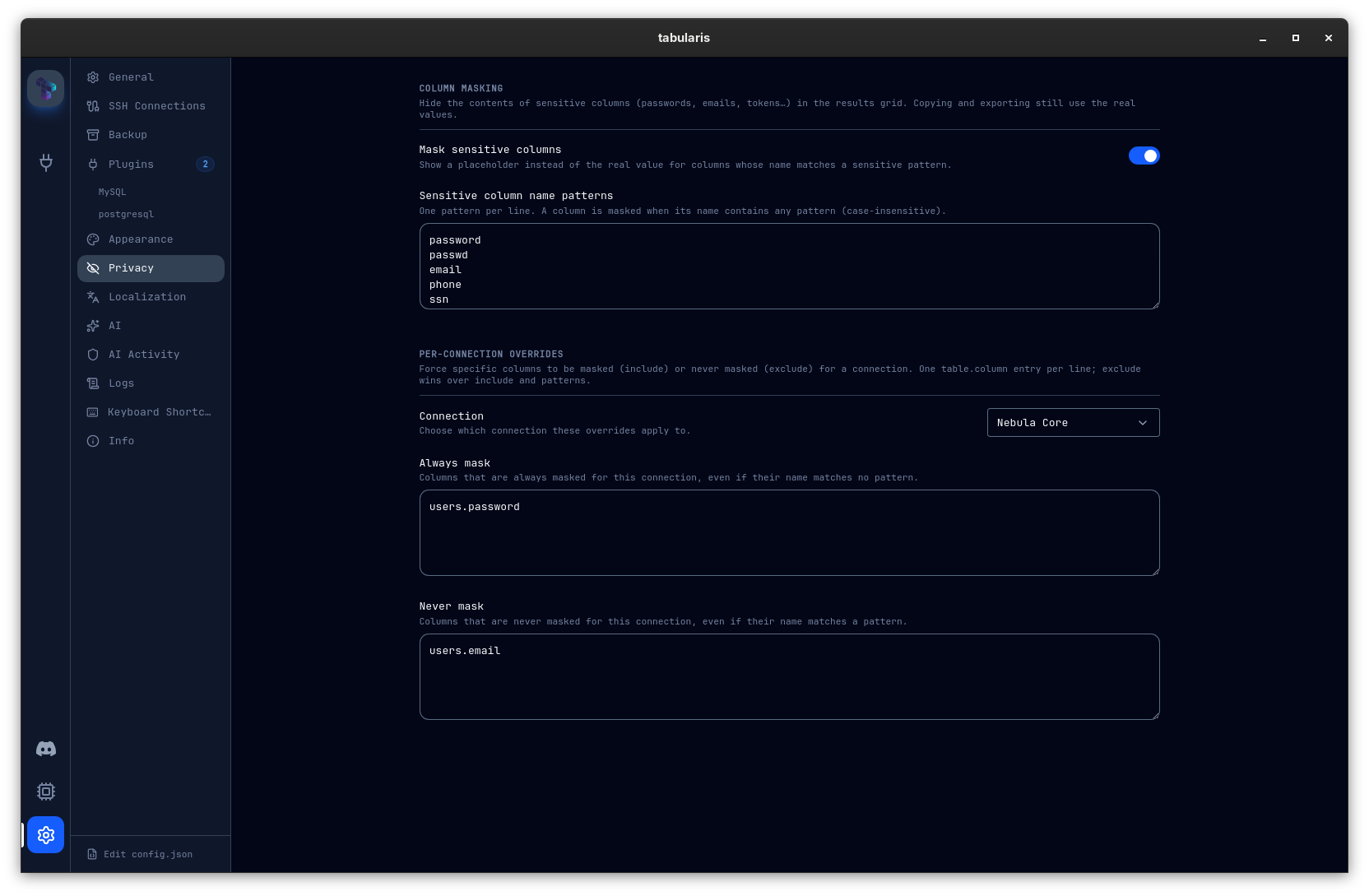
Screen-sharing a results grid used to mean hoping nobody could read fast. PR #587, from @iamthenuggetman, closes #485: columns whose name matches a sensitive pattern — password, email, token, ssn and friends — now render as a •••••• placeholder in the results grid.
- Per-cell reveal. A masked cell shows an eye button that reveals just that cell; revealed cells get an eye-off to re-mask. Column headers carry the same toggle for the whole column. Reveal state is grid-local and resets when the result data changes.
- The mask actually holds. Masked cells can't be edited — double-click, Enter and F2 are guarded until you reveal — and the hover tooltip is suppressed so it can't leak the value.
- Display-only, by design. Copy and export keep the real values, as the issue requested; write-path anonymization for exports is tracked separately in #483.
Video unavailable
Configuration lives in a new Settings → Privacy tab: an on/off toggle (default on), the column-name patterns as an editable list of case-insensitive substring matches, and per-connection overrides as table.column entries — Always mask and Never mask lists per connection, where never-mask wins over always-mask, which wins over the name patterns. A review round moved the per-connection overrides into the connection modal as well, so a saved connection can manage its own exceptions from a Privacy tab in edit mode. Strings are translated across all eleven locales.
Tables Without a Primary Key Are Now Editable
A table with no primary key refused every edit and never said why: double-click did nothing, the row-editor sidebar accepted input but never showed a submit button, and Set NULL, Set EMPTY and Delete Row were silent no-ops. This wasn't a regression — row addressing has always required primary-key columns, and every path that needed them bailed out silently. PR #600 (closes #598) makes keyless tables editable, carefully.
Rows of a keyless table are now identified by the values of all their comparable columns. Binary, geometric, json and hstore columns are excluded — their grid representations wouldn't survive an equality comparison — and so are approximate numerics (FLOAT, DOUBLE, REAL), whose stored values may not match the grid's decimal rendering. Excluded columns stay editable; they just don't take part in addressing. The fallback only activates when the result set exposes every physical column of the table: a partial SELECT a, b FROM t stays non-editable, because it couldn't distinguish rows that differ only in the omitted columns — and the grid now says so in an explanatory alert instead of ignoring the double-click.
The mechanics are fussy and worth getting right. Without a key, each UPDATE invalidates the value its own WHERE clause will need next time, so updates to the same row run sequentially with already-applied values threaded into each step. Columns set to DEFAULT — whose stored result the client can't know — are ordered last and dropped from later WHERE maps, so applying DEFAULT to two columns of one row works instead of failing halfway. Deletions repeat until every duplicate the grid marked is gone: MySQL and MariaDB delete one copy per statement with LIMIT 1, PostgreSQL and SQLite sweep identical rows in one statement, and every driver converges on the state the grid displayed. And when the row no longer matches — someone changed the data underneath you — a zero affected-rows result raises a clear error instead of pretending it worked.
On the driver side, the pk map can now legitimately carry a whole row: NULL entries render as IS NULL instead of being rejected, booleans bind natively across MySQL, PostgreSQL and SQLite, and MySQL updates and deletes by pk map carry LIMIT 1 so duplicate rows are never swept by a single statement. The changes were verified live against MySQL 8.4, PostgreSQL 16, SQLite, and a MariaDB 11 container loaded with the reporter's actual dump.
The Plugin Pipeline Closes the Gap
Five threads landed this cycle that together move plugin drivers from "supported" toward "indistinguishable from built-in".
BLOB, materialized views and type mappings reach plugin drivers (@aesslinger, PR #576). The RPC adapter now forwards save_blob_to_file and fetch_blob_as_data_url — the plugin writes the file directly, since it runs on the host machine — plus all four materialized-view methods. A plugin that doesn't implement a method returns JSON-RPC -32601 and the host falls back to the existing "not supported" error, so nothing changes for current plugins. A new optional type_mappings manifest field lets a plugin resolve map_inferred_type() locally, which matters because that method is synchronous and can't issue an RPC call. These are the prerequisites for migrating the PostgreSQL driver itself to a plugin (#16).
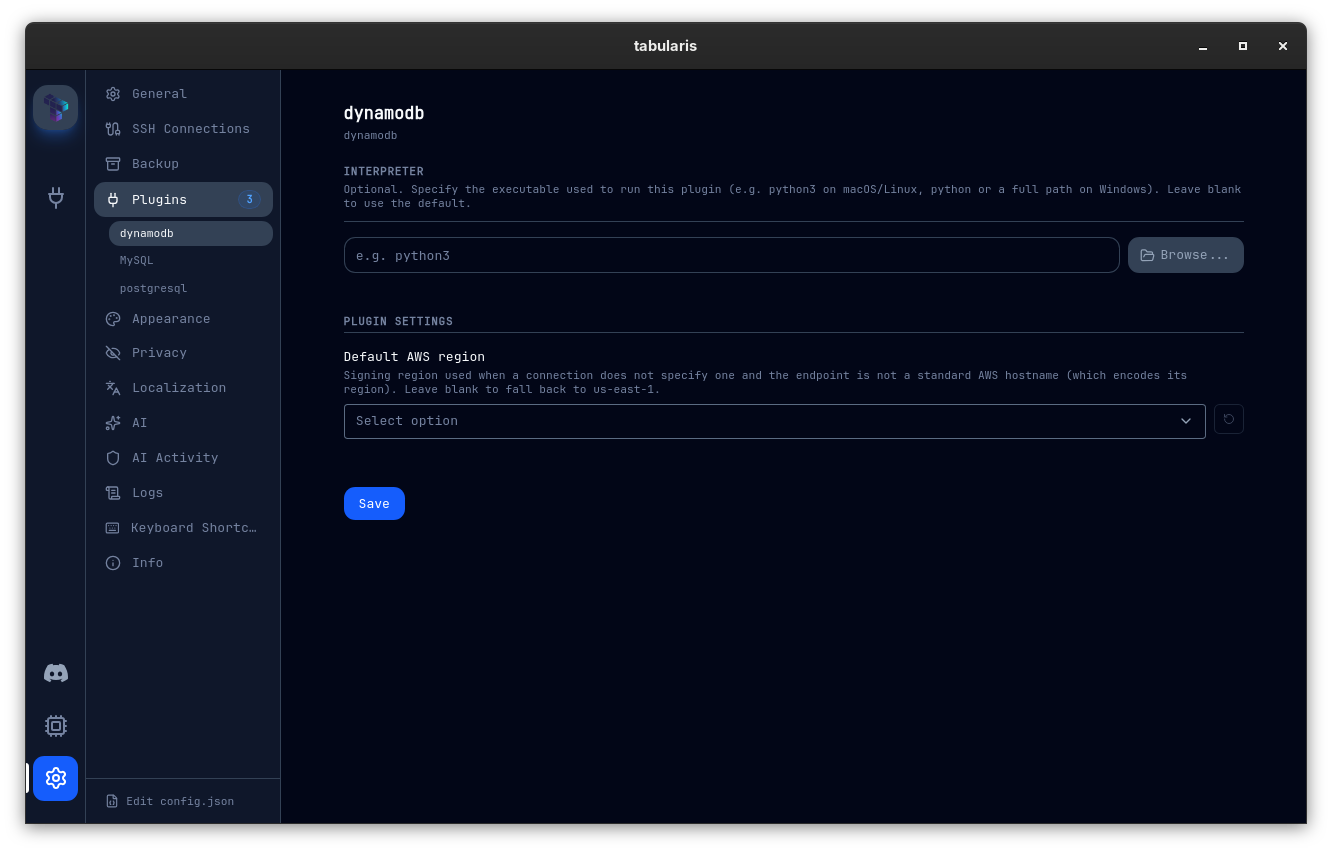
Plugins get their own connection fields (@fuleinist, PR #596). ConnectionParams gains an opaque extra string map — persisted verbatim, forwarded to the driver, absent from JSON when empty — and a new connection-modal.extra_fields slot renders plugin UI below the host/port section, with setExtraField(key, value) to edit the map. The concrete beneficiary is the DynamoDB plugin, which needs an AWS region without asking core for a schema change. The host API version moves to 0.2.0.
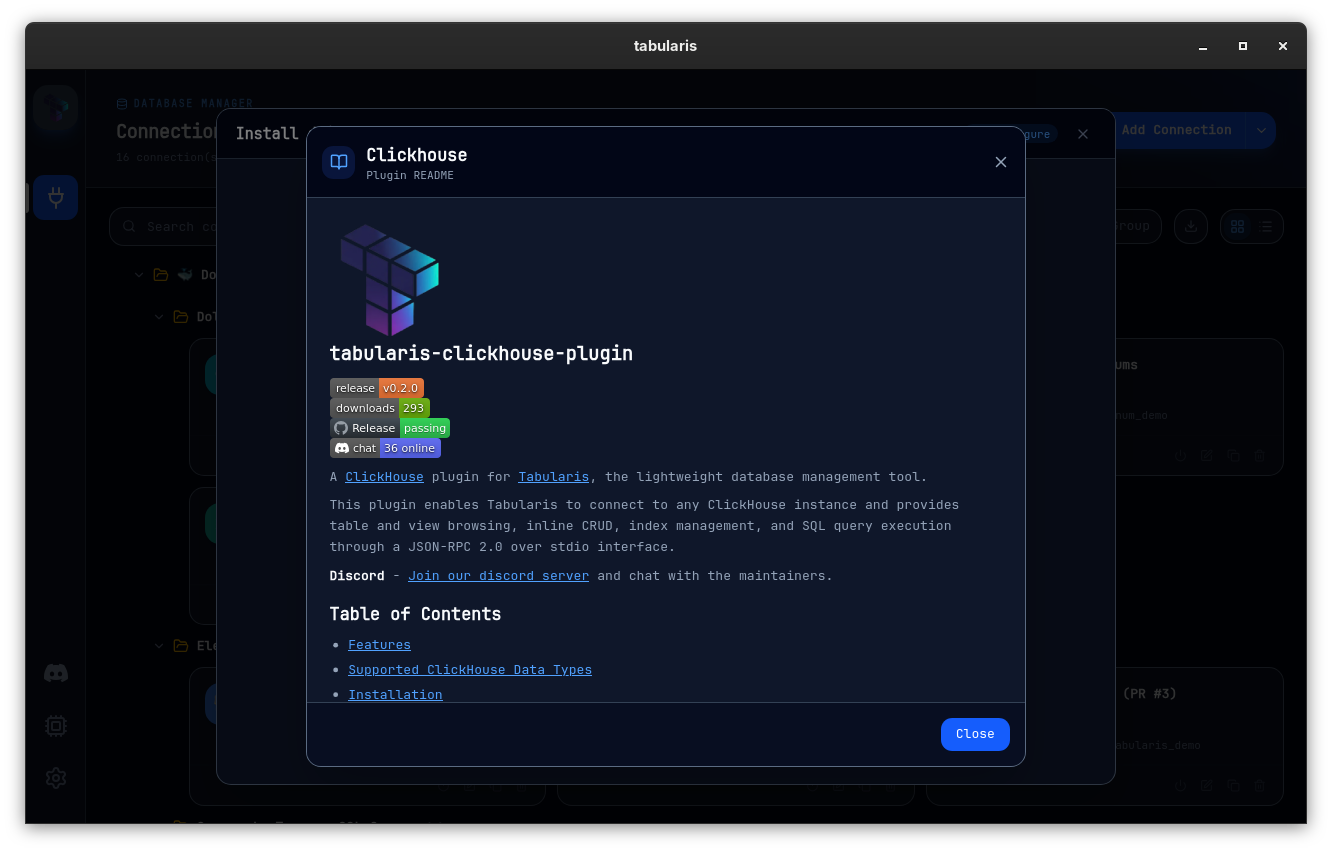
Plugin READMEs open in the app (PR #615). Deciding whether to install a plugin used to mean a detour to GitHub. A WordPress-style details modal now shows the plugin's README — from the connection install gate and from every Plugin Center card the registry knows. The registry serves the README locale-aware, relative image and link paths are resolved against the plugin's repository, the HTML is sanitized with DOMPurify, and links open in the OS browser. The install gate also declutters: while the driver isn't installed yet, the connection-name input and environment selector stay out of the way.
A bad archive can no longer eat a good install (PR #609). The manifest id and version are now verified against what the registry advertised while the bundle is still in the temp directory — previously the check ran after the archive had already replaced the plugin folder, so a corrupt download could wipe out a working installation. Uninstall resolves plugins by manifest id even when the folder name differs, and the install-error modal gains "Open plugins folder" and "Reload plugins" buttons, so a broken half-install is recoverable from the UI instead of requiring a restart and a file manager safari.
.tabularium is the canonical manifest, and the scaffold finally validates (@NewtTheWolf, PRs #594 and #595). The manifest create-plugin scaffolded failed live registry validation on four counts — missing engine and paradigms, a forbidden id field, and a display name where the slug belongs. It now renders a manifest the registry accepts, and the in-repo plugin docs stop describing the old manifest.json world: slug name, optional legacy id, publishing pointed at registry.tabularis.dev/submit. Relatedly, the twelve plugins already migrated to the hosted Tabularium registry were removed from the legacy registry.json, which keeps only the five not yet migrated — and the MongoDB Atlas entry now points at the official TabularisDB repository and its published v0.1.0 release (@Robbyfuu, #496).
The AppImage Stops Bundling a Time Bomb
If Tabularis gave you a black window on Arch or Solus since v0.13.3, this is the fix. The AppImage bundled the build container's libwayland (Ubuntu 22.04, ~1.20); on distros with a recent Mesa, the host libEGL bound to that stale libwayland-client, protocol marshalling mismatched, and WebKitWebProcess aborted with EGL_BAD_PARAMETER. This is a known-enough failure class that the upstream AppImage excludelist added libwayland-client.so.0 for exactly this reason — but the linuxdeploy binary pinned by tauri-cli predates that entry, and upstream has declared the linuxdeploy bundler unmaintained.
PR #599 (fixes #423) attacks the root cause and the process failure behind it. The stable build path pre-seeds a patched linuxdeploy-plugin-gtk.sh that strips libwayland-*.so* from the AppDir before the squashfs is packed — the produced AppImage contains zero libwayland files where v0.18.0 shipped four. And release.yml is rewritten as a thin dispatcher over the same reusable build.yml matrix the nightlies use, because the regression existed at all only because the two workflows had drifted apart: nightlies kept a working configuration for months while releases shipped the broken one. Two channels, one build definition, no more drift.
Smaller Things
- The MySQL Visual Query Builder qualifies its tables (@DhruvShah-Dev, PR #582, fixes #480) — tables dragged from the sidebar keep their schema, and generated
FROMandJOINclauses are schema-qualified, so a query built against a non-default database runs instead of erroring on the wrong one. - Visual EXPLAIN understands parameterized queries (@DhruvShah-Dev, PR #580, fixes #565) — explaining SQL with
@paramsnow opens the same parameter modal the editor uses, reuses saved tab values when complete, and saves submitted values back to the tab. A follow-up fix gave the modal's submit button a label that exists in the locale files instead of a raw i18n key. - SQLite paths starting with
~work (@DhruvShah-Dev, PR #579) —~/and~\are expanded before file validation, shared between pool creation and new-database creation, so a home-relative path no longer fails as "file not found". - Closing your last connection sticks (@fuleinist, PR #578, closes #548) — the persistence effect skipped empty states, so disconnecting everything and quitting brought the connections back on next launch. Empty is now a state worth saving too.
- Engine cards in the connection catalogue got a cleanup (PR #605) — cards are titled after the engine with proper spellings (PostgreSQL, MongoDB Atlas, SQL Server) instead of whichever plugin sorts first, the layout stops truncating names and clipping the meta line mid-word, the unavailable badge shrinks to one word with the full sentence in a tooltip, and a registry icon that fails to load falls back to the generic database icon.
- The DynamoDB plugin reached v0.1.5 (@fuleinist, PR #607) — two registry bumps this cycle, the latest adding the official DynamoDB brand icon to the manifest.
Thanks
Seven external contributors land in v0.19.0.
@pokertour built the headline feature for the second release running: colored tags, environment classification and the production write guard (#473). @iamthenuggetman gave the results grid column masking with per-cell reveal and a Privacy settings tab (#587). @fuleinist added plugin-owned connection fields to ConnectionParams (#596), fixed disconnects that didn't persist (#578), and kept the DynamoDB plugin moving (#607).
@aesslinger closed the plugin driver feature gap with BLOB, materialized-view and type-mapping forwarding (#576). @DhruvShah-Dev landed three fixes: schema-qualified MySQL visual queries (#582), parameters in Visual EXPLAIN (#580), and SQLite home-path expansion (#579). @NewtTheWolf made the plugin scaffold pass registry validation and rewrote the manifest docs around .tabularium (#594, #595). @Robbyfuu pointed the MongoDB Atlas registry entry at the official release (#496).
If you've ever run a script against production that you meant for staging, screen-shared a grid full of email addresses, or double-clicked a cell in a keyless table and watched nothing happen — this is the upgrade.


v0.19.0 is available now. Update via the in-app updater, or download from the releases page.