


v0.16.0 follows v0.15.0 and is the release where the plugin ecosystem stops being a JSON file in a git repo and becomes infrastructure: a hosted registry, a searchable driver catalogue built into the New Connection flow, one-click installs from a browser link, and two new community drivers — Elasticsearch and Cloudflare D1 — to install through it. Around that core: Kubernetes tunnels learn to use your kubectl and your kubeconfig, connections back themselves up encrypted to a folder or a WebDAV server, the SQL editor runs the statement under your cursor, and MySQL connections can authenticate against AWS RDS with IAM.
A Hosted Plugin Registry and a New Connection Catalogue
Until now, discovering a Tabularis plugin meant knowing it existed: the registry was a static registry.json, and installing meant finding a GitHub release yourself. PR #299, a long-running effort from @NewtTheWolf, replaces that with the hosted Tabularium registry at registry.tabularis.dev — and rebuilds the New Connection flow around it.
- A driver catalogue is now step one. Creating a connection starts from a searchable grid of every engine Tabularis can talk to — built-in drivers and registry plugins merged into one view, with paradigm facets to filter by. Built-ins lead, and drivers your platform can't run are badged and dimmed instead of being a click-through dead end. An uninstalled driver is install-gated: pick it, install it inline, connect.
- Deep-link installs.
tabularis://install/<slug>links open the app with a version-aware confirmation — Install, Update when a newer version exists, or an already-up-to-date notice. Plugin pages on the web can now be one click from a working driver. - Fully backwards compatible. The legacy
registry.jsonis still merged in (the API wins on conflicts), so older plugins stay visible and already-shipped app versions keep working. All of the compatibility code is markedCOMPAT(registry-ga)so it can be removed mechanically once migration completes. - Tooling for authors.
@tabularis/create-plugin0.2.0 scaffolds the new.tabulariummanifest format, adds amigratecommand that converts legacymanifest.jsonplugins, and emits a registry-ready release workflow that publishes the manifest as a release asset the registry resolves directly.
The weeks after the merge hardened the transition paths: installed plugins that drop out of the hosted listing stay updatable instead of silently losing their update button, legacy manifest.json bundles install and list again, legacy-only plugins no longer link to a 404 on the API, and the Installed tab finally has an Update button next to the plugin it's telling you to update.
Video unavailable
Two New Community Drivers: Elasticsearch and Cloudflare D1
Two community-built drivers joined the registry this cycle.
Elasticsearch, by @erwin-lovecraft (repo, added in PR #476), brings cluster inspection to Tabularis: index browsing with stats, a mapping viewer for fields and nested structures, and document sampling. Queries run in three modes selected by a shebang on the first line — Elasticsearch SQL by default, #!esql for ES|QL, and #!rest for raw REST requests with the method and endpoint on the first line and the body below. It requires Tabularis 0.15.0 or newer.
Cloudflare D1, by @GabrielMalava (repo, registered in PR #430), talks to Cloudflare's serverless SQLite over the D1 HTTP API with per-connection credentials: browse every D1 database in your account, inspect tables, indexes, foreign keys and views, run paginated queries, edit rows, and manage tables, indexes and views — ER diagram included.
Plugin drivers also got more capable underneath: batch query RPCs are now forwarded to external plugin drivers (@haos666, PR #443), and a new explain driver capability (PR #491) means the Visual EXPLAIN button only appears for drivers that actually implement it, instead of failing at click time.
Kubernetes Tunnels, With Your kubectl and Your kubeconfig
Tabularis's Kubernetes port-forwarding always used whatever kubectl was first on the PATH and the default kubeconfig. If you juggle multiple clusters, wrap kubectl in a corporate shim, or keep per-project kubeconfig files, that assumption was the feature's ceiling. PR #365, from @metalgrid, adds advanced settings to Kubernetes connections — both inline and saved — that override the kubectl binary and the kubeconfig file per connection.
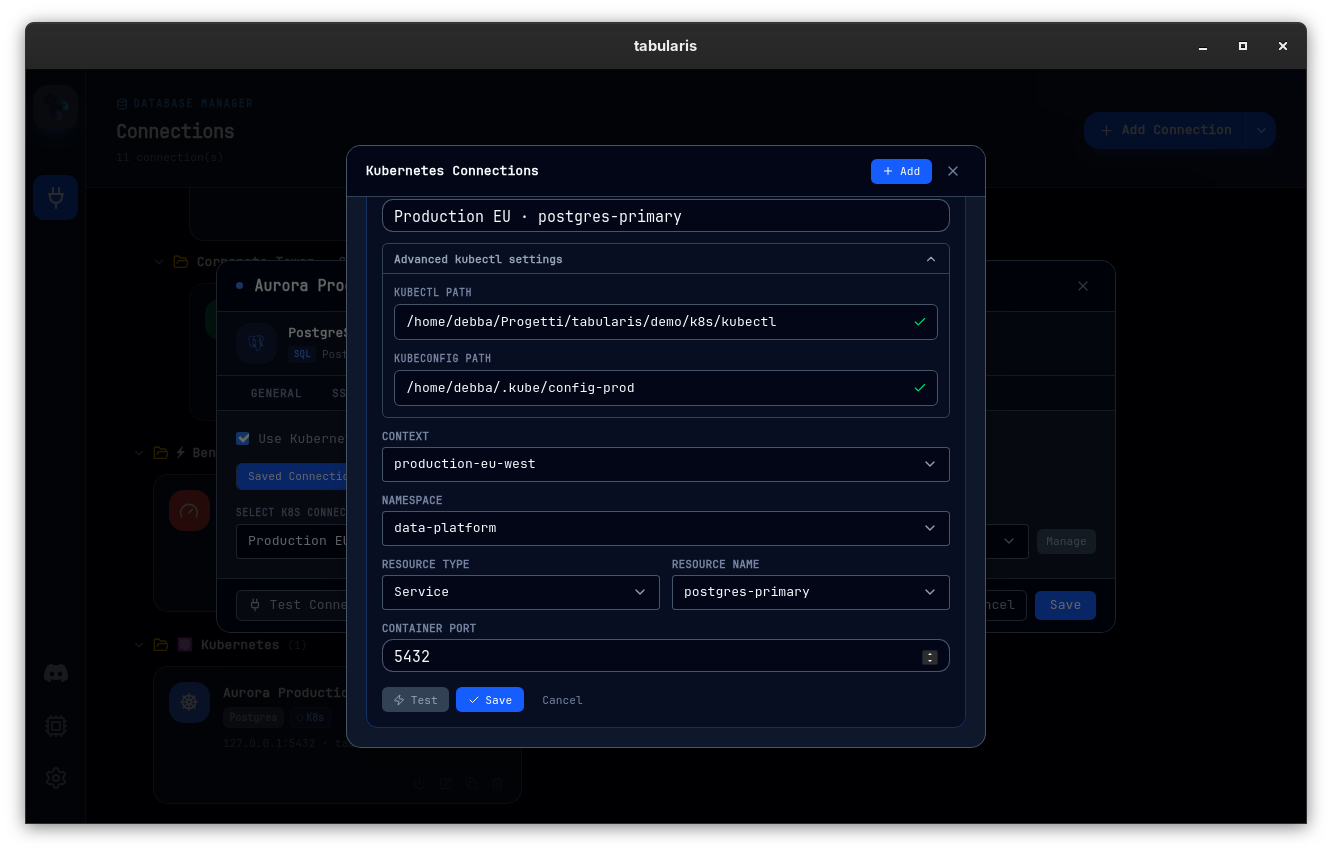
The override paths are validated before they're used: an on-blur preflight checks that the pair actually works, incomplete pairs are refused before apply, and cancelling the modal cancels the validation instead of letting it land on a closed form. Tunnel cache keys now include the overrides, so two connections pointing at the same host through different kubeconfigs no longer collide on the same cached tunnel. The new settings are translated across all supported locales.
Backups That Take Themselves
v0.15.0 gave connection exports proper encryption. v0.16.0 makes them automatic. PR #470, from @pokertour, adds a dedicated Backup tab in Settings that periodically writes an encrypted export of your connections — same AES-256-GCM / Argon2id envelope as the manual export, and deliberately only that: plaintext automatic backups are not an option.
- Triggers: manual, on an interval (6h/12h/daily/weekly presets or a custom value, with the next run time shown), on app launch, or on app close — the exit backup is bounded by a timeout so the app can always quit.
- Destinations: a local folder, or a WebDAV collection (Nextcloud and friends). Rotation honors your retention count and only ever touches
tabularis-backup-*.jsonfiles, so it can't eat anything else living in the same directory. - Secrets stay in the keychain. The encryption password and the WebDAV credentials live in the OS keychain, never in
config.json, and the scheduler re-reads its config every minute so settings changes apply without a restart.
Video unavailable
Run the Statement Under Your Cursor
The single most-used editor action got the TablePlus treatment. PR #464, from @maximumbreak, makes Cmd/Ctrl+Enter run the SQL statement the cursor is inside when nothing is selected — no more whole-file execution or a "pick a statement" popup. A subtle highlight shows which statement is armed, Explain follows the same rule, and Run All moves to Cmd/Ctrl+Shift+Enter with a dedicated entry at the top of the Run dropdown. Selecting text still runs exactly the selection.
Making back-to-back statement runs easy exposed two long-standing result bugs, fixed in the same PR: an in-flight column-metadata fetch could resolve late and stamp the wrong table's primary key onto the current result, and pagination or post-edit refresh re-sent the whole editor buffer — which PostgreSQL rejects as "multiple commands in a prepared statement" once the buffer holds more than one. Both paths now track the exact last-run statement per tab, and stale async responses detect themselves and drop out.
And if you liked the old picker: @GabrielMalava added a Query Execution toggle in Settings → General in PR #487 — running the statement under the cursor stays the default, but switching it off brings back the query-selection dialog for multi-statement scripts.
Video unavailable
AWS RDS IAM Authentication for MySQL
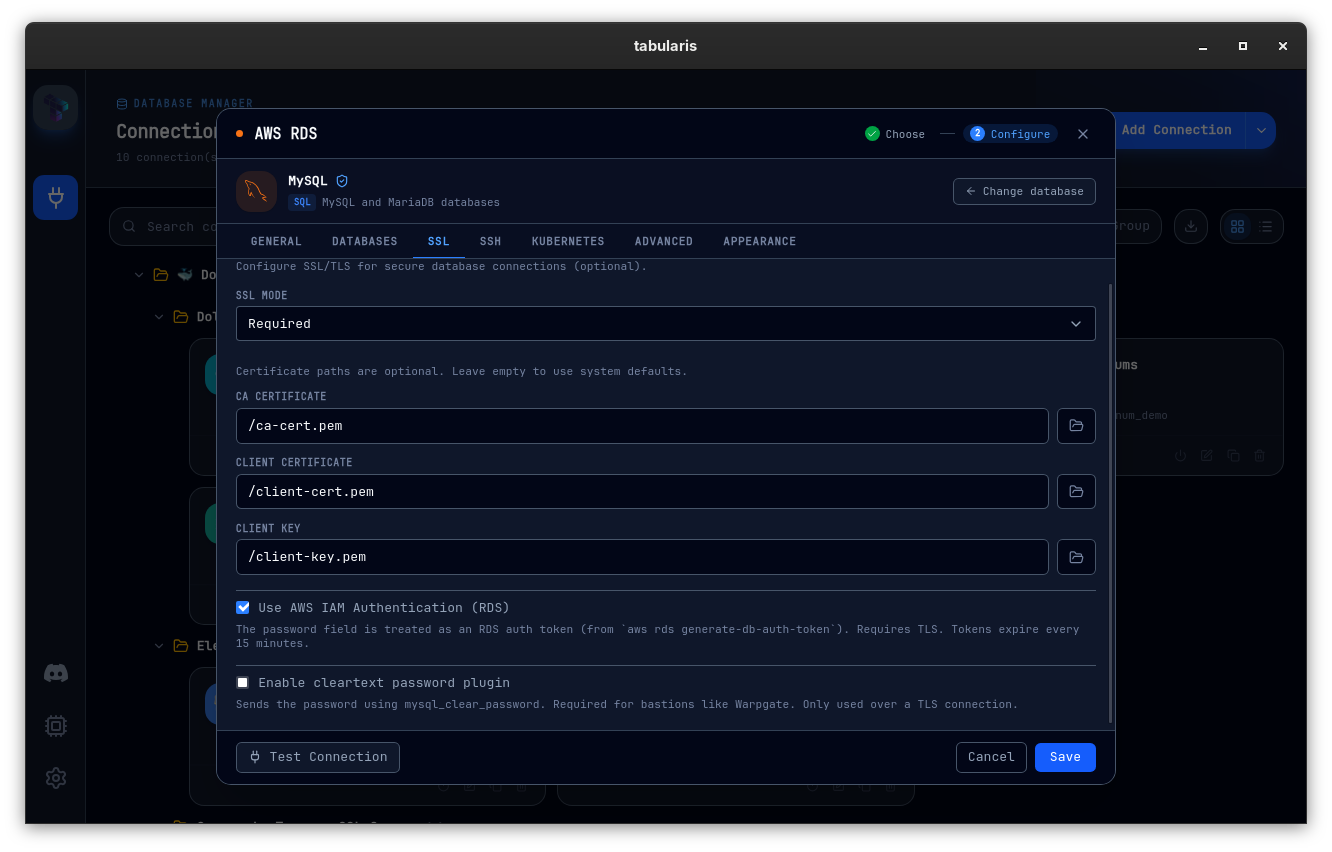
If your MySQL lives on RDS behind IAM database authentication, Tabularis can now speak it. PR #404, from @p4pupro, adds a Use AWS IAM Authentication (RDS) option to MySQL connections: the password field carries a generated RDS auth token (they expire after 15 minutes, so the token must be supplied per connect — the keychain is deliberately bypassed), and TLS is mandatory and enforced on every path, so a token can never travel in the clear. Connections with IAM enabled and a CA bundle configured are auto-escalated to certificate verification, empty-token mistakes fail fast with an actionable message instead of an opaque 1045 Access denied, and a macOS-specific TLS handshake failure with the RDS regional CA bundle was fixed by moving the MySQL TLS backend to rustls with the OS trust store kept active — so corporate CAs in the system keychain keep working on every platform.
Stored Procedures Show All Their Result Sets
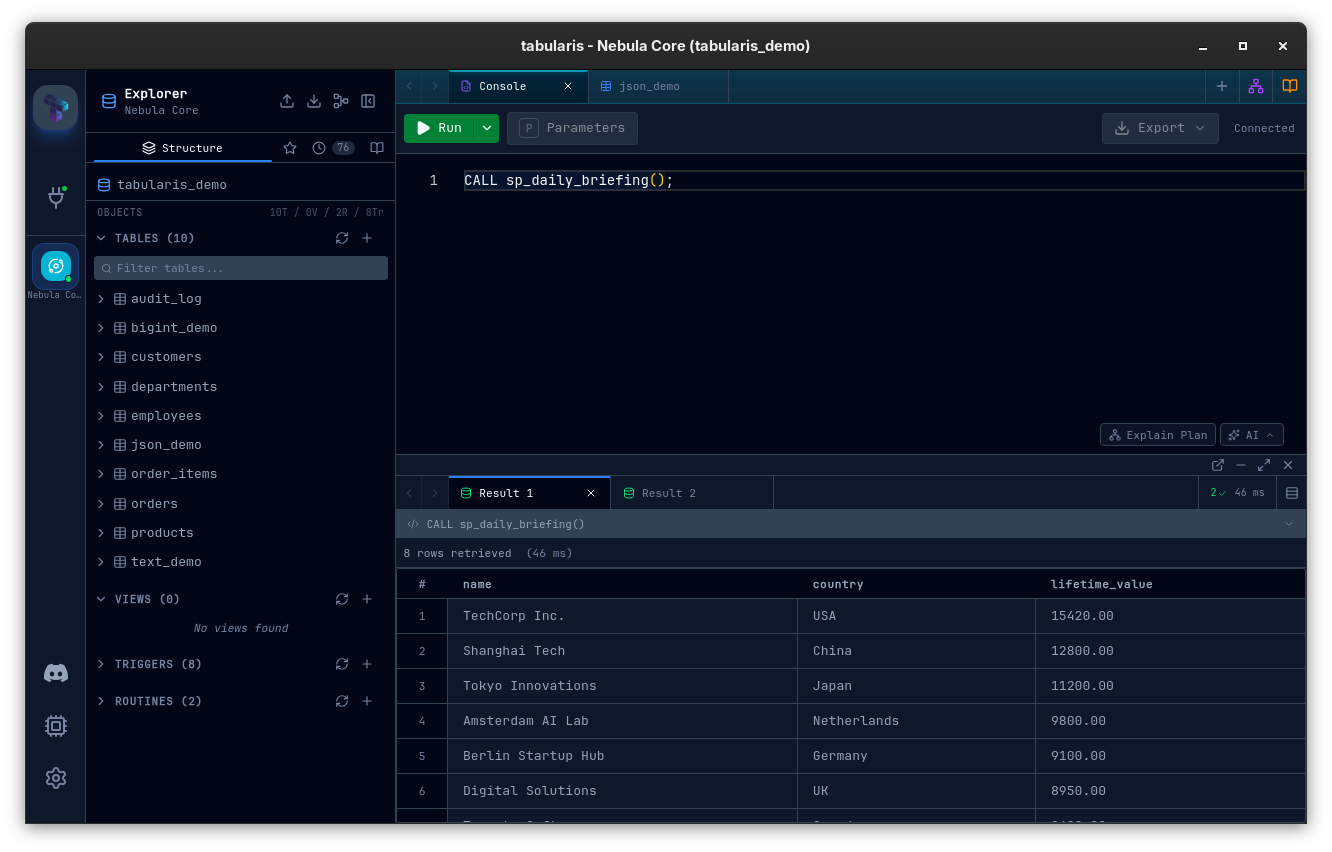
A MySQL CALL to a stored procedure with several SELECTs streams back several result sets — and Tabularis only ever showed the first one. PR #415 (fixes #414) rebuilds the MySQL execution path around result-set boundaries: every set now arrives, rendered through the multi-result tab UI with one tab per result set, and the per-page row cap applies to each set independently. The extra sets travel in a new optional field that other drivers and plugins simply never see, so nothing else changes shape. One known limit: a result set with zero rows is indistinguishable from the statement's OK packet at the driver level, so empty sets are still dropped.
Tabularis Speaks Korean
@moduvoice contributed a complete Korean locale in PR #463 — all 1,574 strings, every interpolation placeholder intact, plus a translated README linked from the language switchers. That makes ten UI languages.
Smaller Things
- Copy rows as a Markdown table (@pokertour, PR #481, closes #474) — the grid's copy and export menus gain a Markdown table format, ready to paste into a PR description or a wiki page.
- MCP transport no longer corrupts itself (PR #488, fixes #486) — keychain lookups and SSH/K8s tunnel setup logged to stdout, which in MCP mode interleaves with the JSON-RPC frames; clients like Warp dropped the connection with "Transport closed" on queries that had actually succeeded. All runtime logging now goes to stderr.
- JSON in the row editor, not
[object Object](@NewtTheWolf, PR #475, closes #428) — JSON/JSONB values from JOINs, UNIONs and aggregates arrive without column metadata; the row editor now recognizes structured values on their own and opens the JSON editor for them. - Smart quotes normalized in filters (@Davydhh, PR #439) — a
WHERE name = “foo”pasted from a chat app no longer fails; curly quotes in filter and sort clauses are normalized to the straight quotes SQL expects. - MiniMax key status (@octo-patch, PR #454) — the AI settings now show whether a MiniMax API key is configured, like every other provider.
- Nightly builds, properly gated (@NewtTheWolf, PR #419) — signed nightly builds now ship as one tag per build (
nightly-<date>-<sha>), cut only from the newest commit that passed CI, laying the groundwork for a selectable nightly update channel. - Linux builds run on older distros again (PR #490) — release and nightly Linux builds moved into an Ubuntu 22.04 container, lowering the glibc baseline so the
.deband AppImage keep working on older LTS systems. - Plugin uninstall no longer trips on empty config (PR #501) — uninstalling a plugin that never wrote a config crashed on macOS; the null case is now handled.
Thanks
Eleven external contributors land in v0.16.0.
@NewtTheWolf built the release's centerpiece: the hosted Tabularium registry and the connection catalogue (#299), plus the gated nightly pipeline (#419) and the row-editor JSON fix (#475). @metalgrid made Kubernetes tunnels configurable with kubectl and kubeconfig overrides (#365). @pokertour added automatic encrypted backups (#470) and Markdown table export (#481).
@maximumbreak brought run-at-cursor to the editor (#464). @p4pupro added AWS RDS IAM authentication for MySQL (#404). @erwin-lovecraft built the Elasticsearch driver plugin (#476) and @GabrielMalava the Cloudflare D1 one, registered in #430 — and also made the cursor-run behavior configurable (#487).
@moduvoice translated the entire app into Korean (#463). @haos666 forwarded batch query RPCs to plugin drivers (#443), @Davydhh normalized smart quotes in filters (#439), and @octo-patch surfaced the MiniMax key status (#454).
If you've been waiting for plugins you can discover and install without leaving the app, if your databases live behind a corporate kubectl, or if you've ever wished your connections backed themselves up — this is the upgrade.


v0.16.0 is available now. Update via the in-app updater, or download from the releases page.